


Our Unseen Fellow Travellers
When we talk about a human footprint on the Moon, we usually mean the iconic boot prints left in the lunar dust. But the new 'biological footprint' is something far smaller and more pervasive. Humans are walking ecosystems, shedding millions of microbes
from our skin, breath, and every surface we touch. It's an unavoidable part of being alive. These bacteria and fungi get into spacecraft, cling to suits, and can be released into the environment. While robotic probes can be intensely sterilised by baking them at high temperatures, the same is not possible for missions carrying people. This means that wherever humans go, our microbial companions are sure to follow, posing a unique challenge for planetary protection.
A Priceless Scientific Record at Risk
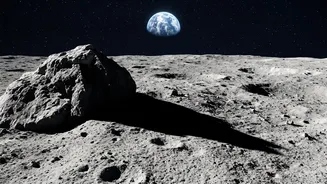
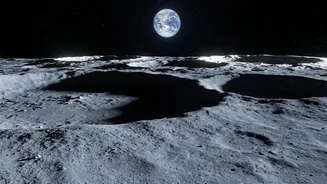
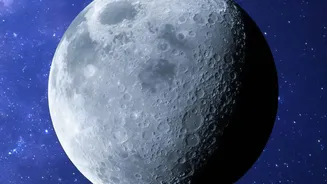
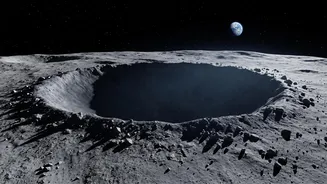
Why does this matter? The Moon is not just a barren rock; it’s a 4.5-billion-year-old time capsule. Because it has no atmosphere, wind, or water, its surface has preserved a pristine record of the solar system’s history, bombarded only by radiation and meteorites. Scientists believe the permanently shadowed craters at the poles may hold ancient water ice and organic molecules that could offer clues about the origin of life itself. Introducing Earth microbes could permanently corrupt this priceless record. Future scientific analysis might be unable to distinguish between what is truly lunar and what was simply contamination from a terrestrial visitor. It’s like trying to study an ancient, untouched archaeological site after a tour bus has driven through it.
Surviving the Unsurvivable
For decades, the assumption was that the Moon's harsh environment—with its extreme temperatures and unfiltered solar radiation—would kill any terrestrial life. However, a recent NASA-led study published in August 2026 has challenged that notion. Using computer simulations based on data from the Lunar Reconnaissance Orbiter, researchers found that certain microbes could indeed survive, at least for a time. The key is the unique topography of the Moon's South Pole, a prime target for the Artemis missions. The low angle of the sun creates permanently shadowed regions in deep craters, which remain incredibly cold and are shielded from lethal UV radiation. These 'micro-refuges,' some as small as a bootprint, could allow dormant microbes to persist for days, weeks, or even months.
A Balancing Act for Future Missions
The study found that some organisms are surprisingly tough. A common fungus, Aspergillus niger, showed remarkable resilience to UV radiation, outperforming even famously hardy bacteria. It's crucial to note that this research points to survival, not thriving. There is no evidence that these microbes could grow or reproduce on the Moon. Still, their persistence is enough to complicate science. This presents a delicate balancing act for NASA and other space agencies. The goal of Artemis is to establish a human presence, but doing so risks compromising the very scientific questions we hope to answer. The solution isn't to stop exploration, but to be smarter about it. Scientists stress the need to meticulously catalogue the microbes we carry with us, creating a baseline that will help future researchers differentiate between contamination and a genuine lunar discovery. It turns a problem into a grand experiment on the limits of life.