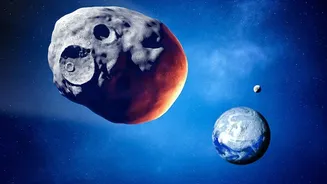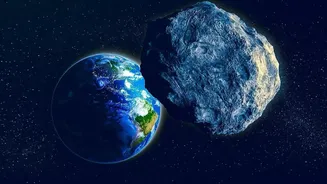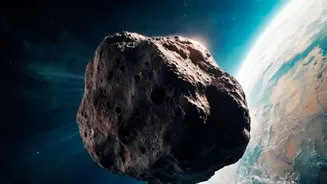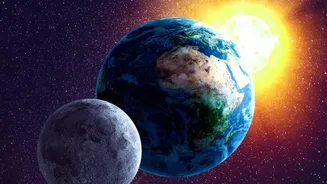





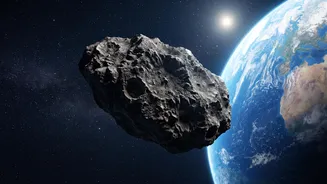
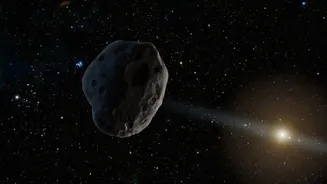
For a few fleeting months, Earth has had a secret companion. A tiny asteroid was captured by our planet's gravity, becoming a temporary 'minimoon'. But this celestial visitor, named 2026 QQ8, is about to say goodbye.
Meet Our Temporary Guest
Our solar system can feel like a busy
place, but Earth has traditionally had only one constant companion: the Moon. Recently, however, our planet gained a second, albeit much smaller and temporary, natural satellite. Designated 2026 QQ8, this object is a tiny asteroid, measuring only about two metres (or six feet) across — roughly the size of a large home appliance. Astronomers use the informal term 'minimoon' to describe small, natural objects like this that are temporarily captured by Earth's gravitational pull. This isn't a permanent relationship; instead, it's more like a brief cosmic visit. The asteroid was pulled into our orbit in April 2026 and has been quietly looping around our planet ever since, far too small and dim to be seen with the naked eye.
The Delicate Dance of Capture
How does a planet like Earth capture a moon, even a temporary one? It’s a matter of cosmic timing and physics. For an object to become a minimoon, it needs to be moving at a similar speed to Earth as it approaches our planet. The asteroid 2026 QQ8 was already orbiting the Sun on a path similar to our own. As it drifted closer, it entered a region of space known as Earth's Hill sphere, an area about 1.5 million kilometres in radius where our planet's gravity is the dominant force. The combined gravitational influence of the Earth and our permanent Moon was enough to perturb the asteroid's path, pulling it from its solar orbit and into a temporary, looping orbit around us. This capture is a delicate balancing act. The object must be slow enough to be caught but not on a direct collision course.
From Discovery to Confirmation
The credit for spotting our tiny companion goes to astronomer Krisztián Sárneczky of Hungary's Konkol Observatory, who first identified the object in August 2026. However, the discovery was just the first step. In the initial stages, it was difficult for scientists to be certain what they were looking at. The object was so small and faint that it could have been a piece of defunct space junk, like a discarded satellite or an old rocket booster. In fact, a famous 'minimoon' from 2020, named 2020 SO, was later confirmed to be a Centaur rocket booster from a failed 1966 NASA mission. To determine the true nature of 2026 QQ8, astronomers used powerful telescopes in Arizona and Hawaii to conduct follow-up observations. By studying how sunlight affected its trajectory over several weeks, they confirmed it was a natural, rocky asteroid and not an artificial object. In late October, it was given its official name by the International Astronomical Union's Minor Planet Center.
Not Our First Cosmic Visitor
While the idea of a second moon sounds extraordinary, 2026 QQ8 is not the first of its kind. Astronomers have documented other minimoons in the past. One of the first confirmed examples was 2006 RH120, a small asteroid that orbited Earth for about a year between 2006 and 2007. More recently, 2020 CD3 spent nearly three years as a temporary satellite of Earth before drifting away. According to Matthew Payne, director of the Minor Planet Center, it's not uncommon for Earth to have a transient companion. He estimates that, on average, there is likely at least one minimoon in our vicinity at any given time. The reason we have a relatively short list of them is because they are incredibly difficult to detect. Their small size and high speed make them a challenge for current sky surveys to spot.
A Swift and Safe Departure
After a brief stay of about eight months, 2026 QQ8's time as our minimoon is coming to an end. Sometime in early December 2026, the small asteroid is expected to escape Earth's gravitational pull and be flung back into its own independent orbit around the Sun. There is no risk of it colliding with our planet. Its orbit never brought it dangerously close; at its nearest, it was still significantly farther away than our main Moon. Even if it were on a collision course, an object of its size would harmlessly burn up in the atmosphere, creating little more than a bright meteor or 'shooting star' for any potential observers. Once it leaves, 2026 QQ8 will continue its journey as just another near-Earth asteroid, having briefly held the title of Earth’s second moon.