


First, A Quick Definition
To understand this cosmic paradox, we need to be clear on what we mean by a “day” and a “year.” A year is straightforward: it’s the time it takes for a planet to complete one full orbit around its star. For Earth, that’s about 365 days. A day, however,
is the time it takes for a planet to complete one full rotation on its own axis. On Earth, that’s about 24 hours. These two clocks—the orbital clock and the rotational clock—are independent, and on most planets, the day is significantly shorter than the year. But Venus is not like most planets.
Venus by the Numbers
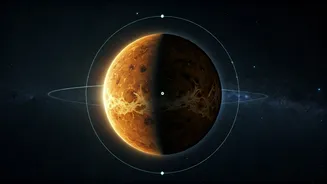
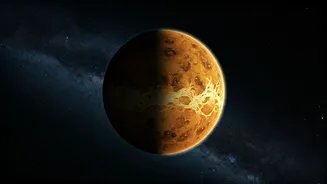
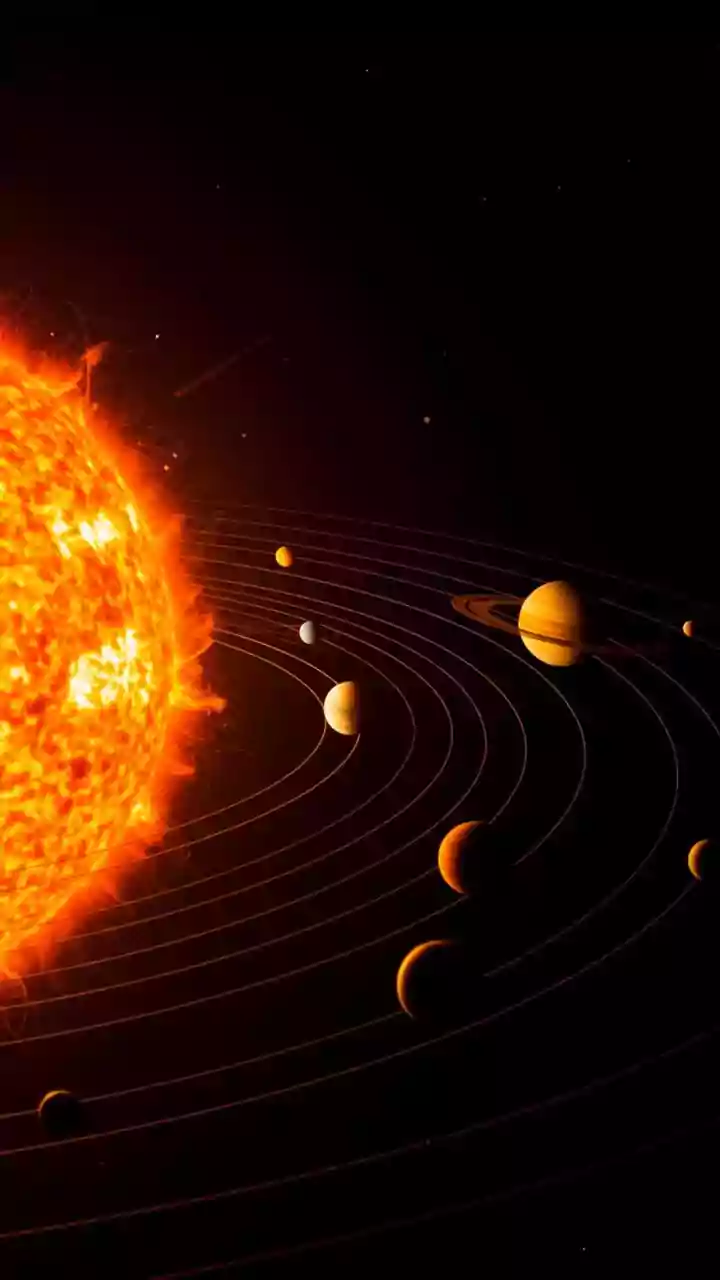
Let's look at the data. Venus takes approximately 225 Earth days to complete one orbit around the Sun. So, a Venusian year is 225 Earth days long. Here’s the twist: it takes Venus a staggering 243 Earth days to spin just once on its axis. This means its rotational period (its day) is longer than its orbital period (its year). You could be born, celebrate your first birthday, and still be waiting for the sun to complete one full cycle as defined by the planet's own spin. This is a planetary-scale mind-bender that sets Venus apart from almost every other body in our solar system.
The Slowest Spin in the Solar System
Why does Venus spin so slowly? Scientists are not entirely sure, but there are a few leading theories. One major hypothesis suggests that Venus may have been struck by a massive asteroid or another planetary body early in its history. Such a cataclysmic impact could have dramatically slowed its rotation, or even reversed it. Another theory points to its incredibly thick and heavy atmosphere—about 92 times more massive than Earth's. The friction between this dense atmosphere and the solid planet, combined with strong atmospheric tides created by the Sun's gravity, might have acted as a brake over billions of years, slowing the planet’s spin to its current crawl.
Sunrise in the West?
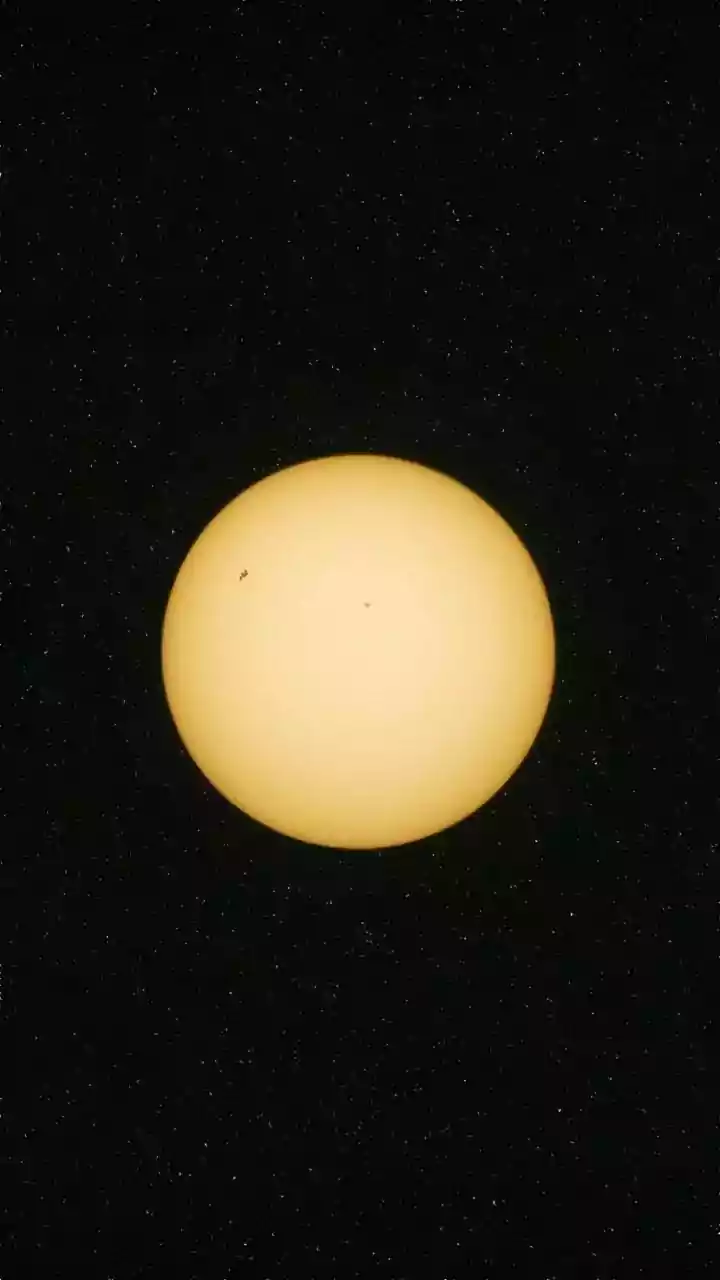
As if a day longer than a year wasn't strange enough, Venus also spins backward. On every other planet in our solar system except Uranus (which spins on its side), the Sun rises in the east and sets in the west. On Venus, due to its “retrograde” rotation, the Sun rises in the west and sets in the east. This backward, slow spin creates another oddity: the length of a solar day (the time from one sunrise to the next) is different from its rotational day. On Venus, a solar day is about 117 Earth days long. So, if you were standing on the surface, you’d experience roughly two sunrises and sunsets for every Venusian year.
What a Venusian 'Day' Feels Like
It’s important to remember that a “day” on Venus is nothing like one on Earth. The planet is a hellscape. Its surface temperature is a blistering 465 degrees Celsius, hot enough to melt lead. The atmospheric pressure is over 90 times that of Earth, equivalent to being nearly a kilometre deep in our ocean. The sky is a perpetual, gloomy yellow, shrouded in clouds of sulfuric acid. The long day means one side of the planet bakes for months while the other side is plunged into a prolonged night, though the thick atmosphere ensures temperatures don't drop much even in the darkness. It is one of the most inhospitable environments imaginable.