




Beyond the Two-Dimensional Universe
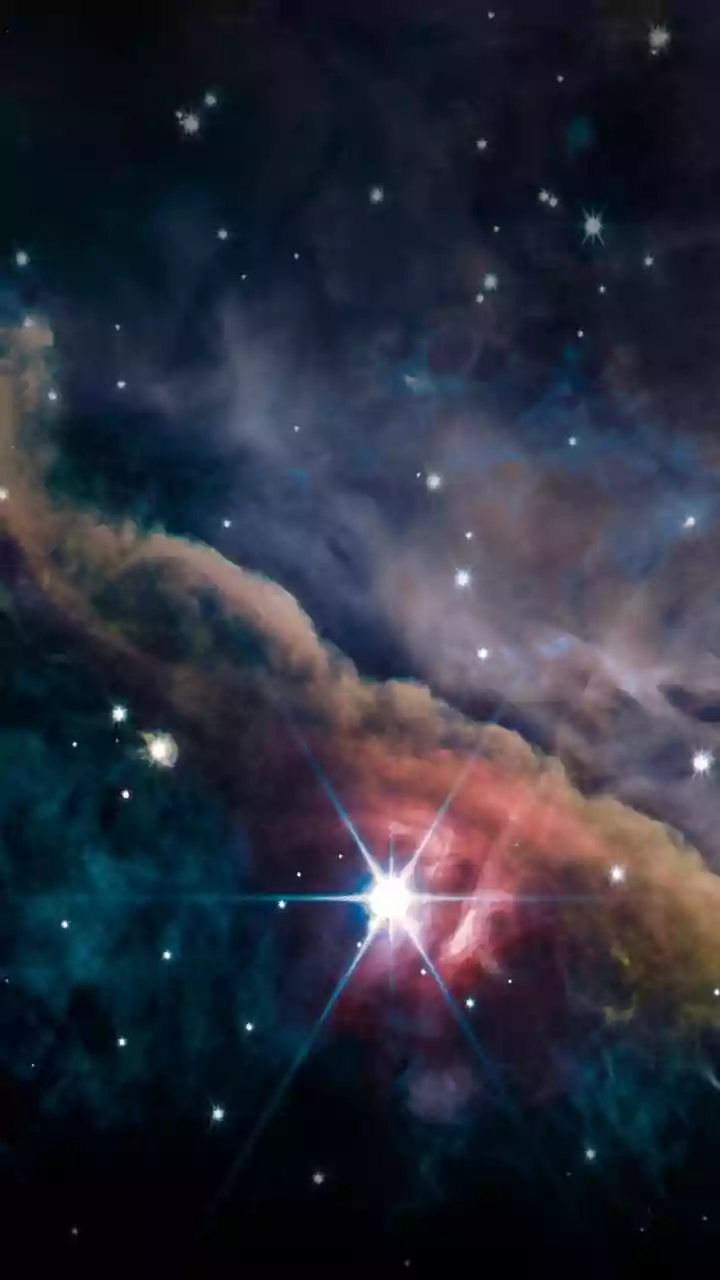
For decades, astronomy captivated the public through powerful, still photographs. Images from the Hubble Space Telescope, like the iconic 'Pillars of Creation,' became cultural touchstones, revealing the haunting beauty of distant galaxies. These pictures
brought the universe to Earth, but they were flat, silent windows into a dynamic, three-dimensional reality. The desire to bridge that gap—to move from passive observation to active participation—has set the stage for a technological revolution in science communication. The goal is no longer just to show people the cosmos, but to let them experience it with a true sense of scale and presence.
The Virtual Reality Spacewalk
Virtual Reality (VR) is at the forefront of this immersive shift. With a VR headset, anyone can now become an astronaut exploring the cosmos. Experiences like 'WebbVR: The James Webb Space Telescope Virtual Experience' place users in orbit, allowing them to fly up to the telescope's golden mirrors or journey through the Orion Nebula. These are not artist's impressions but simulations built from real scientific data collected by NASA. Users can pilot themselves through Saturn's rings, witness the birth of planetary systems, and even simulate the effects of a black hole on a star. Institutions like the Smithsonian are also creating shared VR events, where groups can explore the universe together, translating astronomical data into a collective adventure.
Augmented Reality Brings Stars to You
While VR creates an entirely new world, Augmented Reality (AR) overlays digital information onto our own. This technology is making astronomy more accessible than ever. With AR-powered smartphone apps, you can point your phone at the night sky to identify constellations or see the orbits of planets traced out before your eyes. In education, AR is proving to be a powerful tool. Studies show that allowing students to interact with and manipulate 3D virtual models of celestial bodies can significantly improve their understanding of complex spatial concepts that are difficult to grasp from a textbook. Instead of just reading about the phases of the moon, students can walk around a virtual Earth-Moon system in their own classroom.
Hearing the Music of the Spheres
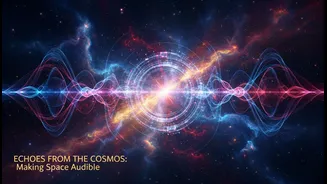
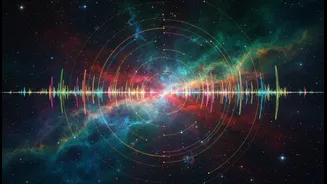
Immersion isn't just about what you can see. Data sonification is an innovative field that translates astronomical data into sound. Since sound cannot travel in a vacuum, scientists assign musical notes and textures to data points like brightness, distance, or chemical composition. NASA's Chandra X-ray Observatory has led projects that turn images of galactic centers, supernova remnants, and nebulae into complex soundscapes. This approach not only provides a captivating new way to experience cosmic phenomena but also serves as a vital tool for scientific analysis and accessibility, enabling blind and low-vision individuals to engage with astronomical data in a meaningful way.
The Planetarium Reimagined
The classic planetarium is also undergoing a radical transformation. Gone are the days of simple, static star projectors. Modern domes are now digital, immersive visualization environments. Using advanced projection systems and real-time simulation software, presenters can take audiences on data-driven journeys anywhere in the known universe. Some venues are even replacing projectors with massive, curved LED screens to offer unparalleled brightness and clarity. These next-generation domes are becoming multi-purpose spaces, capable of hosting everything from live scientific visualizations and full-dome films to interactive art installations, ensuring they remain relevant and captivating hubs for collective learning and discovery.