







Bengal's Capital Before Calcutta
Long before Kolkata became the capital of British India, Murshidabad was the epicentre of power, wealth, and culture in Bengal. Situated on the banks of the Bhagirathi river, this city was the seat of the Nawabs of Bengal, who ruled over a prosperous
territory that included modern-day West Bengal, Bangladesh, Bihar, and Orissa. Visiting Murshidabad is like stepping back into the 18th century, to a time when the fate of the subcontinent was being decided in its courts and on its battlefields. The city's air is thick with history, offering a crucial context for understanding the subsequent rise of British Calcutta and the dawn of colonial rule.
The Palace of a Thousand Doors
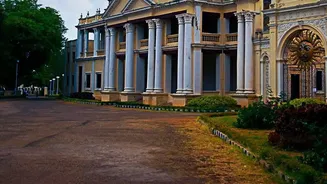
The crowning jewel of Murshidabad is the Hazarduari Palace, an imposing structure that commands attention from every angle. Commissioned in the 1830s by Nawab Nazim Humayun Jah, its name translates to "Palace of a Thousand Doors." The name is a clever misnomer; while the palace has 114 rooms, it features around 1,000 doors, of which 100 are false. These were ingeniously designed by the Scottish architect Colonel Duncan Macleod to confuse potential intruders, giving the Nawab's guards time to apprehend them. The architecture itself is a striking example of the Indo-European style, blending grand Doric columns and Italianate features with the needs of a Nawabi court.
A Museum of Nawabi Treasures
Since 1985, the palace has been managed by the Archaeological Survey of India (ASI) and converted into a breathtaking museum that provides a window into the opulent lifestyle of the Nawabs. The collection is vast, featuring 20 galleries filled with thousands of artifacts. Among the highlights is the Armoury gallery, which displays weapons used in the pivotal Battle of Plassey. The Durbar Hall houses the second-largest chandelier in the world, a gift from Queen Victoria. Visitors can also marvel at a portrait gallery, rare manuscripts, exquisite furniture, and even a 'mystery mirror' that doesn't show your reflection but reveals others in the room—a security feature from a bygone era.
Beyond the Palace Walls
A trip to Hazarduari is incomplete without exploring the surrounding Nizamat Kila campus. Directly opposite the palace stands the colossal Nizamat Imambara, the largest of its kind in India. The campus also includes the Murshidabad Clock Tower, the historic Madina Mosque, and the formidable Bacchawali Tope, a massive cannon with a legendary past. Just a short distance away, you can visit other significant sites like the Katra Mosque, the final resting place of Nawab Murshid Quli Khan, and the Jafarganj Cemetery, where Mir Jafar and his descendants are buried.
Planning Your Journey from Kolkata
Murshidabad is highly accessible from Kolkata, making it an ideal weekend or even a long day trip for history enthusiasts. The journey by road is approximately 200 kilometres and takes about five to six hours via NH12. Several trains also connect Kolkata (Sealdah or Kolkata station) to Murshidabad or the nearby Berhampore Court station, with a travel time of around three to four hours. To make the most of your visit, consider starting early to beat the traffic. It's important to note that the Hazarduari Palace museum is closed on Fridays. Hiring a local guide near the palace can greatly enhance the experience by bringing the rich stories of the Nawabs and their era to life.