

The Inevitable Pull of Drag
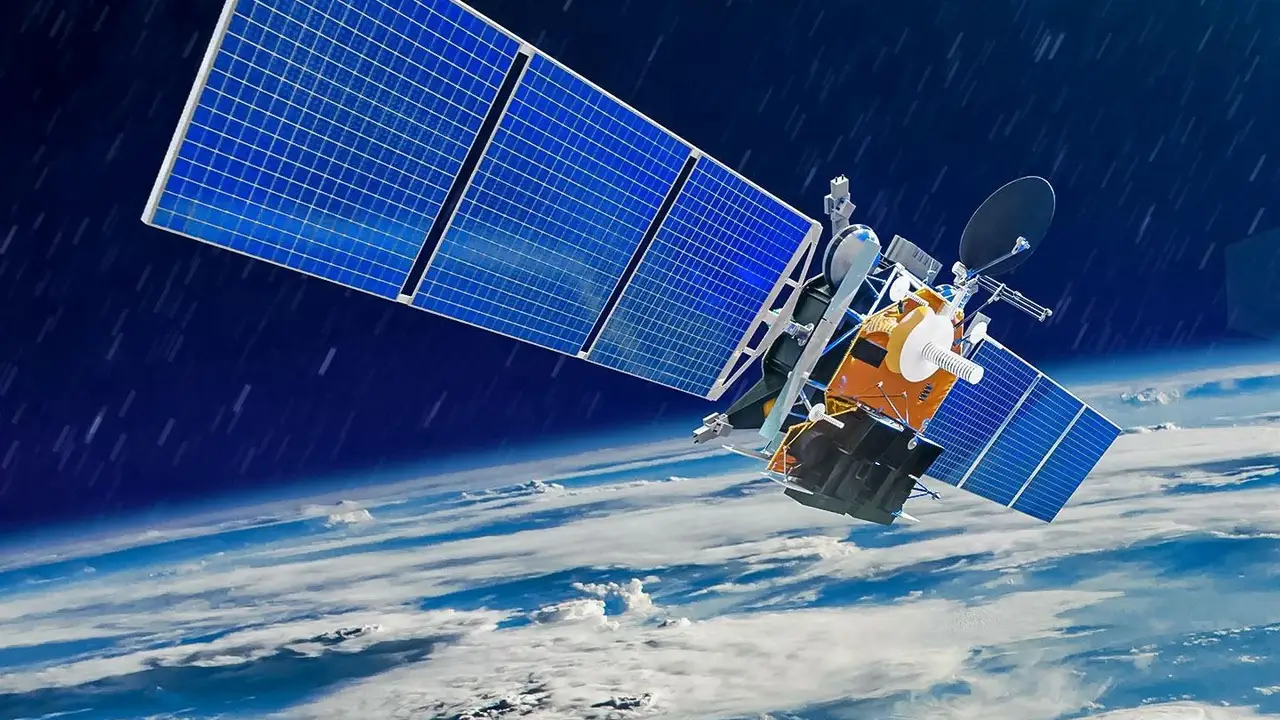
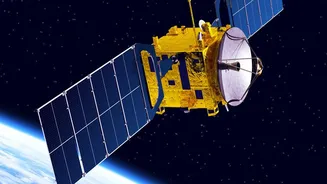
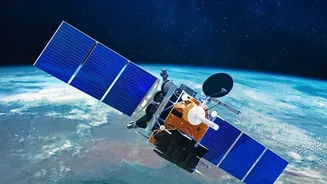
Space may seem like a perfect vacuum, but for satellites in low-Earth orbit (LEO)—altitudes below about 1,000 kilometres—it’s not empty at all. There are still stray air molecules, and at orbital speeds of nearly 8 kilometres per second, hitting these
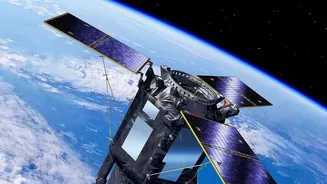
molecules creates significant drag. This drag constantly slows a satellite, causing its orbit to decay. To survive, LEO satellites must carry on-board propellant and periodically fire their thrusters to boost themselves back up. This fundamental limitation defines their lifespan; once the fuel runs out, the satellite’s mission is over, and it eventually falls back to Earth, burning up in the atmosphere. The European Space Agency’s GOCE gravity-mapping satellite, for instance, operated at a very low 250 km, but its four-year mission ended when its 40 kg of xenon propellant was exhausted.
A Revolutionary Concept: Breathe the Air
What if a satellite didn’t need to carry its fuel? This is the game-changing idea behind Air-Breathing Electric Propulsion (ABEP), sometimes called RAM-EP. First proposed in the 1960s, the concept has seen a surge in research and development from space agencies and private companies in Europe, Japan, and the US. Instead of fighting atmospheric drag, an ABEP system uses it. The technology is designed to scoop up the very air molecules that cause drag and use them as an inexhaustible propellant for an electric thruster. In theory, a satellite equipped with this system could counteract drag indefinitely, powered only by its solar panels.
How Does It Actually Work?
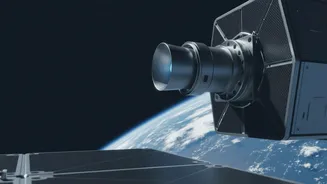
An air-breathing propulsion system consists of two main parts: a special intake and an electric thruster. The intake, or collector, is designed to passively funnel scarce atmospheric particles—mostly atomic oxygen and nitrogen at these altitudes—into the thruster, compressing them in the process. Once inside, the particles are ionised, meaning they are given a positive electric charge. An electric field, generated using solar power, then accelerates these newly created ions and ejects them at high speed. This process creates a small but continuous thrust, pushing the satellite forward and counteracting the atmospheric drag. There are no complex valves or moving parts; the system is remarkably robust. The key is generating enough thrust to perfectly balance the drag force, a condition known as achieving a "break-even" state.
The Promise of Very Low Orbits
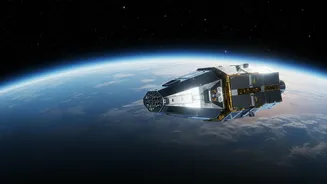
Mastering this technology would unlock a new, valuable region of space: Very Low Earth Orbit (VLEO), typically between 150 and 300 kilometres. Operating closer to Earth offers huge advantages. Earth observation satellites could capture much higher-resolution images, and communication constellations could offer lower latency and stronger signals. It would also promote sustainability; at these altitudes, any space debris or defunct satellites naturally de-orbit and burn up within weeks or months, making the region inherently self-cleaning. By eliminating the need for on-board propellant, ABEP would dramatically extend mission lifetimes, reduce launch mass and costs, and create a new class of long-duration surveillance and science missions.
From Lab to Orbit
While the concept is powerful, the engineering is complex. ABEP systems must operate in a narrow sweet spot, where the atmosphere is dense enough to provide propellant but not so dense that the drag overwhelms the thruster. The highly corrosive atomic oxygen in VLEO also poses a durability challenge for satellite materials. Despite these hurdles, progress is rapid. In 2018, a team led by the European Space Agency (ESA) and Italian aerospace company Sitael announced the world's-first successful ground test of a complete air-breathing thruster prototype. Researchers at JAXA, Japan’s space agency, are also actively developing their own version called the Air Breathing Ion Engine (ABIE). Multiple projects are now transitioning from research to demonstration, aiming to prove the technology works not just in a vacuum chamber, but in space itself.