




An Ejection Seat for a Spaceship
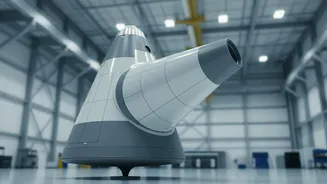
At the heart of the Gaganyaan mission's safety promise is the Crew Escape System (CES). Think of it as a highly advanced ejection seat, but instead of just pulling out the pilot, it yanks the entire three-person crew module away from the main rocket in a fraction
of a second. This system is designed to activate automatically if onboard computers detect a catastrophic failure during any phase of the launch. The goal is simple but critical: get the astronauts clear of a malfunctioning rocket and bring them back to Earth safely. The CES consists of a series of powerful, quick-acting solid-fuel motors that can produce acceleration far greater than the launch vehicle itself. This ensures the crew module is pulled away with immense force and speed.
Planning for Every Contingency
Rocket launches are complex, and potential failures can occur at different stages. ISRO has therefore engineered multiple abort scenarios to cover the entire ascent. A 'pad abort' would be used if an emergency occurs on the launchpad before liftoff. Other aborts are designed for the transonic phase, when the rocket breaks the sound barrier and experiences immense aerodynamic stress. The high-altitude abort is arguably one of the most complex. At this stage, the rocket is travelling at hypersonic speeds high in the atmosphere. An abort here requires the CES to not only separate the crew module but also stabilise it and ensure it follows a precise trajectory for a safe descent and landing.
The High-Altitude Escape in Action
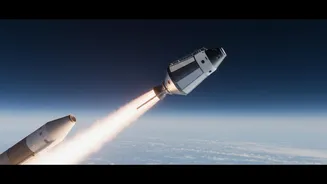
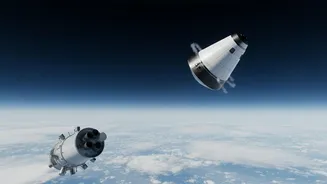
If a critical anomaly is detected at high altitude, the mission's Integrated Vehicle Health Management system triggers the abort sequence. The High-altitude Escape Motor (HEM), a key component of the CES, ignites instantly. This powerful motor pulls the crew module away from the launch vehicle with tremendous force. Once at a safe distance, the escape system jettisons itself, and the crew module begins its autonomous descent. A carefully orchestrated sequence of parachute deployments begins. First, smaller drogue parachutes deploy to stabilise and slow the module from high speeds. Following this, the main parachutes unfurl, ensuring a gentle splashdown in the Bay of Bengal, where recovery teams from the Indian Navy will be on standby.
Proof in Performance: The TV-D1 Test
This is not just theory. ISRO has rigorously tested these systems to ensure they work flawlessly when needed most. A major milestone was the Test Vehicle Abort Mission-1 (TV-D1), which successfully demonstrated the performance of the Crew Escape System in a real-world flight scenario. During this test, a specially designed test vehicle was launched to an altitude of about 17 km. An abort was deliberately triggered, simulating a launch failure at a speed of Mach 1.2 (slightly above the speed of sound). The CES performed exactly as planned, pulling the uncrewed module away from the rocket. The parachutes deployed correctly, and the module was successfully recovered from the sea, validating the entire sequence from abort initiation to recovery.
A Multi-Layered Safety Net
The high-altitude abort manoeuvre is a critical part of a broader, multi-layered safety philosophy for the Gaganyaan mission. The launch vehicle itself, the LVM3, has been 'human-rated', meaning it meets much stricter reliability and safety standards. The crew module is a pressurized, habitable space designed to protect the astronauts from the harsh environment of space. Recent tests have also validated other crucial safety components, such as the system that ensures the capsule remains upright after splashdown and the mechanism for separating from the service module before re-entry. Every component and procedure is being tested and re-tested to make human spaceflight as safe as humanly possible.