



A Promising Discovery
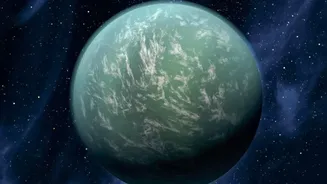
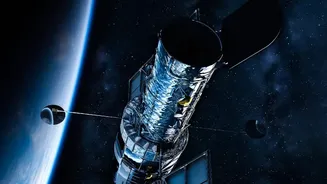
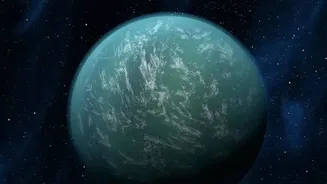
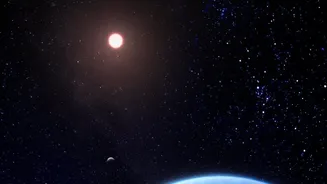
Not too long ago, astronomers using NASA's Transiting Exoplanet Survey Satellite (TESS) announced an exciting find. They had spotted a planet orbiting a star roughly 635 light-years from Earth. Named TOI-2535 b, this world is a 'sub-Neptune', meaning
it's smaller than our own Neptune but significantly larger than Earth. It was detected using the transit method, the most common technique for finding exoplanets. Scientists were eager to study it further, but when they pointed their telescopes back at the star, expecting to see the planet make its scheduled pass, they saw nothing. The planet's tell-tale signal was gone.
How a Planet Can 'Disappear'
To be clear, the planet itself didn't just vanish into thin air. What disappeared was its transit—the event that allowed us to see it in the first place. The transit method works by measuring the tiny, periodic dip in a star's brightness that occurs when a planet passes in front of it from our point of view. It’s like noticing a streetlight dim slightly every time a moth flies in front of it. For this to work, the alignment between Earth, the star, and the planet's orbit has to be just right. If that alignment changes, the planet is still there, orbiting its star, but we can no longer see its shadow. It becomes hidden in the star's glare. For TOI-2535 b, its perfectly timed transit simply stopped happening.
The Prime Suspect: An Orbital Tilt
So, what could change a planet’s orbit? The leading explanation for TOI-2535 b's disappearing act is a phenomenon called nodal precession. Think of the planet's orbit not as a flat, fixed ring, but as a giant hula hoop that is slightly tilted. Now, imagine that hula hoop is also slowly spinning like a wobbly coin coming to a rest. This 'wobble' is precession. It means the angle of the planet's orbit, relative to our line of sight, is gradually changing over time. For a while, its orbit was perfectly aligned for us to see the transit. But over the years, this slow tilt has moved the orbital path just enough that the planet no longer crosses in front of its star from our perspective on Earth.
A Hidden Puppeteer at Play
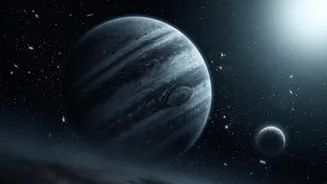
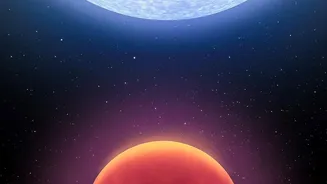
An orbit doesn't just start tilting on its own; something has to be pulling on it. The main theory is that there's a 'hidden puppeteer' in the system: a third, as-yet-unseen giant planet. Astronomers believe this outer planet's immense gravity is constantly tugging on TOI-2535 b, causing its orbit to precess. The initial TESS observations actually hinted at the presence of a second, smaller planet in the system, but the gravitational force needed to create such a significant wobble suggests another, much more massive body is lurking further out. This makes the TOI-2535 system even more complex and fascinating, a multi-planet system locked in a gravitational dance.
Will We See It Again?
The good news is that TOI-2535 b is not lost forever, just temporarily out of view. Based on their models, scientists who studied the phenomenon predict that the orbit will continue its slow precession. Eventually, the tilt will bring the planet back into our line of sight, and its transits will become visible once again. However, patience is required—a lot of it. The current estimates suggest it could take decades for the planet to reappear. This timeline itself provides valuable data, helping astronomers refine their understanding of the gravitational forces at play in this distant solar system. The mystery of the missing planet has turned into a long-term experiment in orbital mechanics.