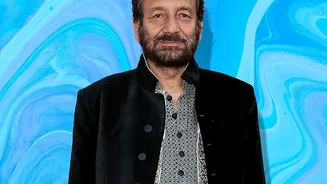







Mr. India (1987): The Practical Effects Pioneer
Long before CGI became the industry standard, Shekhar Kapur's 'Mr. India' brought a homegrown superhero to life with ingenious practical effects. The film’s charm lay in its clever in-camera tricks, which made Anil Kapoor’s invisibility feel magical and real.
Simple but effective techniques, like depressing a chair's cushion to show an unseen person sitting or using clever editing for disappearing acts, were executed live on set. This wasn't just a technical showcase; it was a film that gave India a beloved sci-fi icon rooted in a story of common-man heroism. By blending a fun, comic-book plot with heartfelt emotion and a menacing villain in Mogambo, 'Mr. India' proved that Indian cinema could create a sci-fi blockbuster for the masses without a Hollywood-sized budget, relying on creativity over computers.
Enthiran (2010): The Animatronics and VFX Revolution
Director S. Shankar's 'Enthiran' (released as 'Robot' in Hindi) was a quantum leap for Indian visual effects. The film, starring Rajinikanth in a dual role as a scientist and his emotional android, stunned audiences with its scale and technical polish. To bring the robotic Chitti to life, the production collaborated with international teams, including Stan Winston Studios, known for their work on 'Terminator' and 'Jurassic Park'. The film made extensive use of advanced animatronics and CGI for its futuristic action sequences, especially in the climax where hundreds of robot clones merge into spectacular forms. More than just a showcase of technology, 'Enthiran' explored classic sci-fi themes of humanity and emotion in artificial intelligence, setting a new benchmark for how visual effects could be integrated into ambitious storytelling in Indian cinema.
Baahubali (2015): The World-Building Epic
S.S. Rajamouli’s 'Baahubali: The Beginning' was not just a film; it was the creation of an entire world. While fantasy epics existed before, 'Baahubali' redefined scale and ambition in Indian cinema. Its groundbreaking success was built on a foundation of extensive pre-production, with thousands of storyboard sketches creating the blueprint for the fictional kingdom of Mahishmati. The film seamlessly blended massive practical sets with cutting-edge visual effects, with an estimated 90% of the VFX work completed by Indian studios. Techniques like 3D modelling, matte painting, and animatronics were used to create breathtaking waterfalls, colossal statues, and epic battle sequences that felt both grand and tangible. This meticulous world-building provided a rich canvas for a powerful story of myth and royalty, proving Indian cinema could produce a fantasy epic that could captivate audiences globally.
Tumbbad (2018): The Atmospheric Masterpiece
Innovation isn't always about the biggest budget. The fantasy-horror film 'Tumbbad' demonstrated how technical brilliance could serve a story’s atmosphere above all else. Directors Rahi Anil Barve and Anand Gandhi created a haunting, visually stunning world on a modest budget. The film’s unique look was achieved by shooting almost entirely in natural light and during the monsoon season to capture a constant sense of gloom and dread. Cinematographer Pankaj Kumar used a specific color palette—cold greys and blues transitioning to rich reds and golds—to visually represent the narrative's themes of greed and decay. The creature Hastar was brought to life not with heavy CGI, but with a terrifying combination of elaborate prosthetics and subtle digital enhancements. 'Tumbbad' became a masterclass in using cinematography, production design, and sound to build a deeply immersive and unsettling fantasy world.
Kalki 2898 AD (2024): The New Frontier
Serving as a testament to how far Indian sci-fi has come, Nag Ashwin's 'Kalki 2898 AD' is one of the most expensive Indian films ever made, with a vision to match. The film blends Hindu mythology with a dystopian future, creating a unique cinematic universe. To achieve its futuristic world of Kashi, the production utilized a combination of massive practical sets and state-of-the-art visual effects, with a team of over 1200 artists contributing. Unlike films that rely entirely on green screens, about 30% of the movie was shot on physical sets to give the world a more grounded feel. The project made use of advanced CGI, motion capture, and meticulous pre-visualization to craft everything from futuristic vehicles to entire cityscapes, earning praise as a 'visual wonder' and setting a new standard for visible and invisible VFX in India.