




A Celestial Season of Change
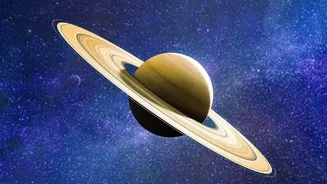
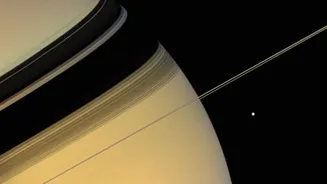
Just as Earth has seasons, so does Saturn. But a year on Saturn is nearly 30 Earth years long, making each season last for more than seven of our years. The planet is currently approaching its northern hemisphere's autumnal equinox, set to occur in May
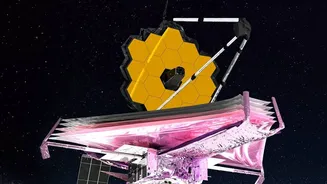
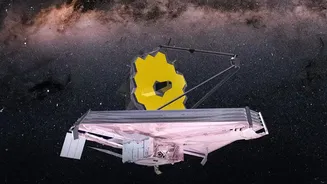
2025. This event, which happens only once every 15 Earth years or so, is when the sun shines directly on the edge of Saturn's rings. Recent observations from the Hubble Space Telescope, particularly in infrared light, are giving scientists an unprecedented look at the dramatic effects of this seasonal shift. The angle of sunlight is changing, altering how the rings are illuminated and how their shadows fall upon the planet's cloudy surface.
The Power of Infrared Vision
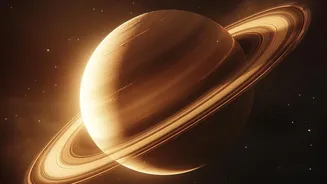
While visible-light images show us the beauty of Saturn, infrared images reveal a different story written in heat. Infrared observation allows scientists to measure thermal radiation. This means that as the rings cast longer shadows over parts of the planet during this pre-equinox period, Hubble can detect how those areas cool down. By studying these temperature changes, researchers can learn more about the properties of Saturn's atmosphere and the composition and density of the ring particles themselves. It's like taking the planet's temperature, providing clues to the complex interplay between the rings and the atmosphere below. The water-ice particles in the rings glow brightly in infrared, making them stand out in stark contrast to the planet itself, which appears darker as its methane gas absorbs infrared sunlight.
The Return of the Ring 'Spokes'
One of the most mysterious phenomena associated with Saturn's equinox is the appearance of 'spokes' on the rings. First observed by the Voyager mission in the 1980s, these are transient, radial features that can look like dark or light smudges across the rings. These ghostly markings seem to appear and become more prominent in the years leading up to and following the equinox. The leading theory is that they are caused by tiny, electrostatically charged dust or ice particles levitating above the main rings due to interactions with Saturn's magnetic field. As the 2025 equinox nears, 'spoke season' is in full swing, and Hubble's long-term monitoring, part of the Outer Planet Atmospheres Legacy (OPAL) program, is providing a wealth of new data for scientists trying to finally solve this decades-old mystery.
A Disappearing Act on the Horizon
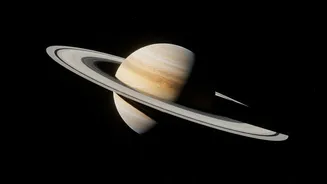
The upcoming equinox will lead to a spectacular illusion for observers. On March 23, 2025, Earth will pass directly through Saturn's ring plane. Because the rings are incredibly thin—only about 30 feet to a kilometer thick in most places—they will seem to vanish from our point of view. This event is known as a ring plane crossing. Unfortunately for most skywatchers, Saturn will be very close to the sun at this time, making it difficult to observe from Earth. However, the lead-up to this event is what makes the current Hubble observations so valuable. They are documenting the final stages before this rare alignment, capturing data that will be compared with observations from past equinoxes, like the one seen by the Cassini spacecraft in 2009, to build a complete picture of Saturn's dynamic system.