
The Ghost of a Star
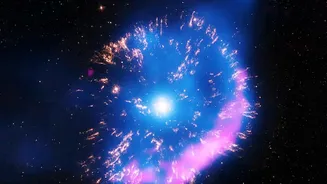
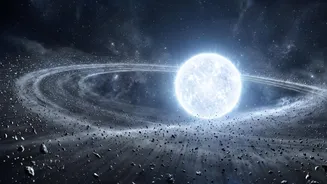
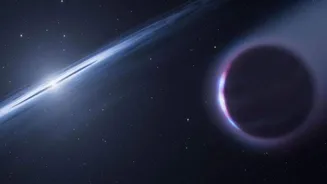
To understand this strange potential nursery, we first need to understand the star at its centre: a white dwarf. A white dwarf is the incredibly dense final stage for a star like our own Sun. After exhausting its nuclear fuel, the star sheds its outer
layers and its core collapses into an Earth-sized ember that slowly cools over billions of years. It is, for all intents and purposes, a dead star. These stellar remnants are common throughout the galaxy, but they have long been considered unlikely hosts for planets, especially any orbiting nearby. The process of becoming a white dwarf is violent, and any close-in planets would have been engulfed and destroyed during the star's preceding 'red giant' phase.
A Cosmic Second Act
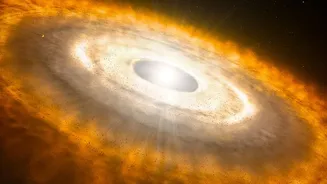
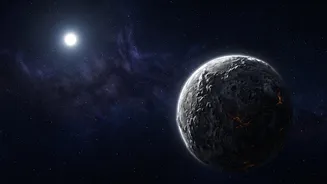
This is what makes the idea of a 'second-generation' planet so radical. While first-generation planets form from the disc of gas and dust surrounding a newborn star, second-generation planets would form much later, from the rubble left over after the star has already died. The theory suggests that after a star becomes a white dwarf, the gravitational pull of the dense remnant can shred surviving asteroids, comets, or distant planets that have been nudged into new orbits. This process can create a brand new 'debris disc' swirling around the white dwarf. It’s from this cosmic wreckage that a new planet could, in theory, coalesce. It would be a world born from the ashes of its older siblings.
The Trail of Indirect Clues
Scientists cannot see these potential planets directly; they are far too small, too dim, and too distant. Instead, they are cosmic detectives following a trail of indirect evidence. One of the most significant clues is the presence of these debris discs themselves. By studying the light from a white dwarf, astronomers can detect the infrared glow of dust and gas orbiting it. Sometimes, the chemical signature of this material tells a compelling story. Astronomers have found white dwarfs whose atmospheres are 'polluted' with heavy elements like magnesium, iron, and silicon. These elements should have long since sunk into the dwarf’s core, so their presence on the surface suggests the star is actively feeding on a nearby debris disc — a disc that could be forming a planet.
Interpreting the Cosmic Shadows
The evidence remains circumstantial, which is why the claim is still considered a 'possibility'. Observing a disc of debris is not the same as observing a planet. The 'pollution' of a white dwarf's atmosphere confirms material is falling onto it, but it doesn't confirm a fully formed planet is the cause. Other clues include strange dips in the star's light, which could be caused by a planet transiting in front of it, or by clumps of gas and dust. In some cases, astronomers observe gaps within the debris discs, which is a classic sign of a planet clearing a path with its gravity, much like a celestial plough. However, these gaps could have other explanations. Every piece of evidence has an alternative interpretation, forcing scientists to be cautious.
Why This Cosmic Mystery Matters
Confirming the existence of a second-generation planet would be a landmark discovery, fundamentally changing our understanding of how and where planets can form. It would prove that planetary formation is not a one-time event that only occurs around young, active stars. Instead, it would show that the universe is creative enough to build new worlds even in the most extreme and seemingly inhospitable environments. This discovery would open up a whole new category of planets to search for and study, suggesting that the end of a star's life might just be the beginning of another world's story. It provides a narrative of resilience and regeneration on a truly cosmic scale.