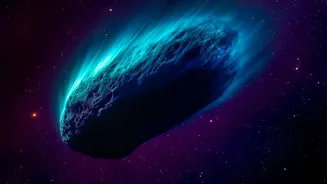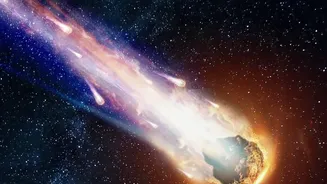





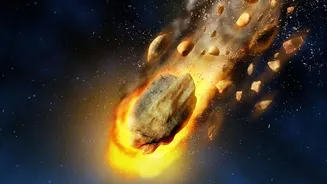
A Special Delivery from Space
Imagine being at home and hearing a crash, only to find a rock has punched a hole through your roof. That’s exactly what happened in New Jersey in 2024, when a meteorite landed in a family’s bedroom. While startling, it was also a golden opportunity for
science. A recent July 2026 analysis of the object provided a definitive answer to its cosmic address. This wasn’t just a random rock; it was a four-pound messenger from the distant past, carrying secrets about the dawn of our solar system. By studying it, scientists were not only able to find its origin but also discover that it contained key ingredients for life. This specific case is a perfect example of how a mysterious fireball can become a solved case, offering clues that benefit all of humankind.
Eyes on the Sky, Everywhere
The first step in solving any meteor mystery is to catch it in the act. For decades, this relied on luck. Today, a global network of cameras is constantly watching. Professional systems like NASA's All-Sky Fireball Network and Australia's Desert Fireball Network use wide-angle cameras to monitor the sky every night. But the game has changed with the rise of citizen science. Your doorbell camera, a dashcam, or a security camera could be the key to the next big discovery. The American Meteor Society regularly uses footage from the public to track fireballs. For the New Jersey meteorite, a combination of professional cameras and a simple doorbell camera helped triangulate the path of the incoming rock. By having eyes in different locations, scientists can build a 3D model of the meteor's flight through our atmosphere.
Hitting the Cosmic Rewind Button
Once astronomers have the trajectory—its speed, angle of entry, and how much it slowed down in the atmosphere—they can perform some incredible cosmic detective work. Using the laws of physics, they essentially hit a rewind button. They calculate its path backward, out of the atmosphere and back into space, to reconstruct its original orbit around the sun. This orbit is the single most important clue to its origin. Was it in a nearly circular path, like many asteroids between Mars and Jupiter? Or was it on a long, stretched-out orbit, a hallmark of a comet? Each object in our solar system has a distinct orbital path, and by calculating the meteor's former route, scientists can start to look for its home address.
Reading the Chemical Fingerprint
Most meteors burn up completely. But when a piece survives the fiery descent and becomes a meteorite, it provides the ultimate clue: a physical sample. Scientists can analyze its composition in a lab. The New Jersey meteorite was identified as a carbonaceous chondrite, a specific type of stony meteorite known to be rich in water and organic compounds. This chemical fingerprint is like a rock's DNA. Different asteroids in the solar system have different compositions. By matching the meteorite's makeup to known asteroid types, scientists can narrow down the list of potential parent bodies. In the case of the New Jersey rock, the analysis not only confirmed it came from the asteroid belt but also revealed it was from an ancient, water-rich protoplanet.
Solving the Case: A Perfect Match
The final step combines the orbital data and the chemical analysis. Astronomers take the calculated orbit of the meteoroid and compare it to databases of thousands of known asteroids and comets. With the New Jersey meteorite, its calculated orbit pointed directly to a region low in the asteroid belt. When the orbital path and the chemical fingerprint both point to the same source region or asteroid family, scientists can declare the case solved. This process has become so effective that we now know the origin of many meteor showers. For example, the spectacular Perseid meteor shower, which peaks every August, is known to be debris left behind by the comet Swift-Tuttle. Each solved mystery adds another piece to the grand puzzle of how our solar system formed and evolved.