







The Monsoon Challenge for Solar Power
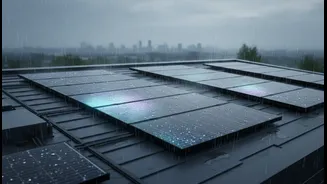
India's push for renewable energy hinges heavily on solar power. Yet, for a significant part of the year—the four-month monsoon season—solar generation takes a considerable hit. Heavy cloud cover, haze, and rain drastically reduce the amount of direct
sunlight reaching panels. On a heavily overcast day, a solar panel's output can drop to as little as 10-30% of its peak capacity. This variability is a major headache for grid operators and households alike, undermining the reliability that is crucial for solar to replace fossil fuels. While modern monocrystalline panels are better at capturing diffuse light than older technologies, the seasonal dip in performance remains a fundamental challenge. This makes innovations that improve low-light performance not just a technical curiosity, but a national priority.
The Promise of Perovskite and Tandem Cells
Enter the game-changer: new materials that are exceptionally good at converting a wider spectrum of light into electricity. The two biggest names in this space are perovskite solar cells (PSCs) and tandem cells, which combine perovskite with traditional silicon. Perovskites are a class of synthetic crystalline materials that are highly efficient, lightweight, and can be manufactured at a lower cost than pure silicon. Their key advantage for cloudy regions lies in their 'tunable' bandgap. This means they can be engineered to excel at absorbing the blue and green light that dominates when sunlight is scattered by clouds, a task where traditional silicon panels are less efficient.
How Tandem Cells Capture More Energy
Tandem cells are the current frontrunners for next-generation solar technology. These cells stack a thin, semi-transparent layer of perovskite on top of a conventional silicon cell. This creates a powerful duo: the top perovskite layer captures high-energy blue light, while the silicon layer below absorbs the remaining lower-energy light that passes through. This tag-team approach allows the panel to harvest energy from a much broader portion of the solar spectrum, significantly boosting efficiency in all conditions, but especially on overcast days. As of mid-2024, researchers have pushed the efficiency of these tandem cells to nearly 35% in laboratory settings, shattering the theoretical limits of silicon-only panels.
Solving the Durability Puzzle
Historically, the Achilles' heel of perovskite has been its vulnerability to moisture and heat—a critical problem for deployment in a country like India. However, recent breakthroughs are systematically addressing this issue. In early 2026, German researchers identified the microscopic stresses that cause degradation and developed molecular 'anchors' to make the crystal structure more robust against weather-induced stress. Other recent innovations include protective, ultra-thin polymer coatings that shield the sensitive perovskite layer from moisture without blocking light. Some of these coatings even have a dual function, using the kinetic energy of raindrops to generate a small electrical charge, turning rain from a problem into a power source.
The Path from Lab to Indian Rooftops
While these advancements are incredibly promising, the technology is still on the journey from the laboratory to mass production. Key challenges remain in scaling up manufacturing while keeping costs low and ensuring the panels can last for 25-30 years like their silicon counterparts. However, the pace of innovation is rapid. Several companies are already running pilot projects and building solar farms to test these new panels in real-world conditions. As durability improves and production scales, these advanced panels could fundamentally change the economics and reliability of solar power in India. They could make solar a viable 24/7 power solution when paired with battery storage, even during the long monsoon months, accelerating the nation's transition to clean energy.