




What is the SKA?
The Square Kilometre Array (SKA) is not a single telescope but a global project to build the world's largest and most sensitive radio observatory. It consists of two separate arrays: SKA-Low in Western Australia and SKA-Mid in South Africa. These locations
were chosen for their remoteness, offering skies that are exceptionally free from the radio frequency interference (RFI) that plagues modern life, caused by everything from mobile phones to satellites. Construction began in December 2022, with India also playing a key role in developing the computational processing required for the immense project. When complete, the SKA will be 50 times more sensitive than any other radio instrument, capable of surveying the sky thousands of times faster.
A Tale of Two Telescopes
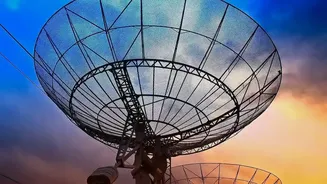
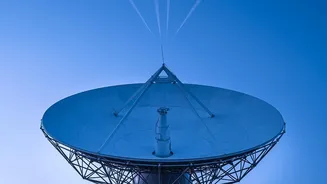
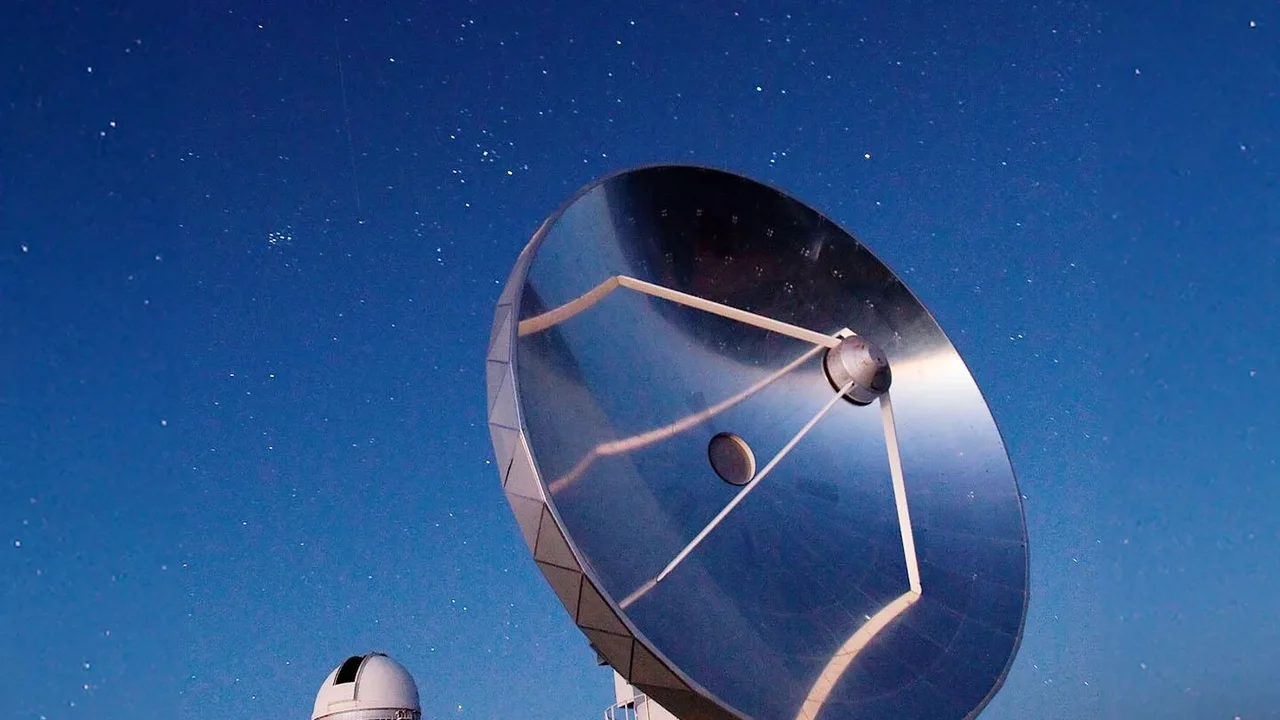
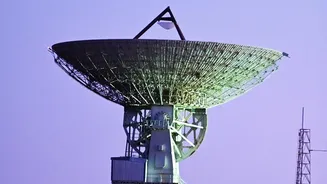
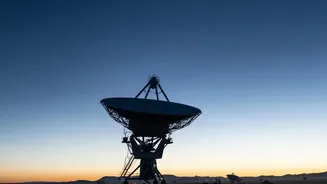
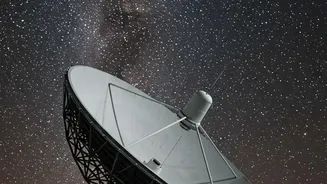
The two sites, SKA-Low and SKA-Mid, are designed to observe different parts of the radio spectrum, complementing each other's discoveries. SKA-Low, located in Australia on the traditional lands of the Wajarri Yamaji, consists of over 131,000 Christmas-tree-like antennas. These are designed to pick up low-frequency radio waves, the kind emitted by neutral hydrogen gas in the very early universe. Meanwhile, SKA-Mid in South Africa features 197 large dishes, including the 64 dishes of the precursor MeerKAT telescope. These dishes will capture mid-frequency signals, ideal for studying everything from pulsars and black holes to the formation of galaxies.
The Power of Many
So how does this collection of antennas listen to such faint signals? The secret is a technique called interferometry. Instead of building one impossibly large dish, the SKA connects thousands of smaller antennas together with fibre optic cables. The signals from each antenna are sent to powerful supercomputers, which combine them digitally. This allows the array to act as a single, virtual telescope with a collecting area equivalent to one square kilometre, giving it its name and its incredible sensitivity. The more antennas in the array, the more faint details it can resolve. Furthermore, by spreading the antennas over vast distances—up to 150 kilometres in South Africa—the telescope achieves an incredibly sharp resolution, allowing it to distinguish fine details in the cosmic structures it observes.
Decoding the Cosmic Dawn
One of the SKA's primary missions is to peer back in time to a period known as the Cosmic Dawn and the subsequent Epoch of Reionization. This was the era, just a few hundred million years after the Big Bang, when the first stars and galaxies lit up and began to ionize the neutral hydrogen gas that filled the universe. The faint radio signal from this hydrogen, known as the 21-cm line, has been stretched by the expansion of the universe to low frequencies. SKA-Low is specifically designed to detect this faint, ancient signal, creating a 3D map of how the universe evolved from darkness to light. By capturing these whispers from the past, scientists hope to answer fundamental questions about how the first cosmic structures formed.
Overcoming Cosmic and Earthly Noise
Detecting these incredibly weak signals is a monumental technological feat. The energy captured by all radio telescopes in history is less than that of a single falling snowflake. To hear the universe, astronomers must first filter out a cacophony of noise. This includes radio frequency interference from human technology, which can easily swamp the faint cosmic signals. Even natural phenomena, like the Earth's ionosphere, can distort the incoming radio waves. The SKA's receivers are cryogenically cooled to just a few degrees above absolute zero to reduce their own electronic noise. Advanced software and machine learning algorithms are also being developed to meticulously clean the data, separating the precious astronomical signals from the overwhelming interference and allowing scientists to see the early universe with unprecedented clarity.