




A High-Speed Junkyard Above Our Heads
Since the launch of Sputnik 1 in 1957, humanity has sent thousands of rockets and satellites into orbit. Many of these objects, along with fragments from explosions and collisions, are still up there, forming a vast junkyard that encircles our planet.
The US military tracks about 20,000 objects large enough to be cataloged, but there are an estimated 900,000 objects over one centimeter in size. Traveling at speeds exceeding 28,000 kilometers per hour, even a tiny paint flake can inflict catastrophic damage on an operational satellite or the International Space Station. This growing cloud of debris heightens the risk of what's known as the Kessler Syndrome: a chain reaction where collisions create more debris, which in turn causes more collisions, potentially rendering parts of Earth's orbit unusable.
The Aggressive Approach: Harpoons and Nets
One of the most direct methods for capturing uncooperative debris is the space harpoon. While the term might conjure images of old seafaring tales, the concept is quite modern. A cleanup satellite would rendezvous with a target—like a defunct rocket stage—and fire a tethered harpoon to create a secure connection. Once attached, the cleanup craft can tow the debris into a lower orbit where it will burn up upon re-entry. The RemoveDEBRIS mission, led by the University of Surrey and co-funded by the European Union, successfully tested a harpoon in orbit back in 2019, proving the concept's viability. In a similar vein, missions have also demonstrated using a giant net to envelop a target. While effective, these capture methods carry the risk of creating more fragments upon impact, requiring precise and careful execution.
The Gentle Touch: Magnetic and Robotic Solutions
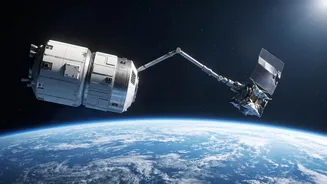
For a less aggressive approach, several companies are developing magnetic capture systems. The Japanese company Astroscale, a market leader in orbital sustainability, has been a pioneer in this area. Its ELSA-d mission successfully demonstrated a magnetic docking system to capture a target. This method is ideal for future satellites equipped with a compatible docking plate, allowing for a standardized and gentle capture. For existing debris not designed with magnets, researchers are also exploring the use of eddy currents, where a rotating magnetic field can induce a force in any conductive object, allowing it to be manipulated without direct contact. Meanwhile, the European Space Agency's ClearSpace-1 mission, slated for launch in 2028, plans to use a set of four robotic arms to gently grab and de-orbit a piece of a Vega rocket left in space since 2013.
A New Commercial Frontier
Cleaning up space is no longer just a hypothetical problem; it's an emerging commercial market. The active debris removal (ADR) market is projected to grow significantly as the number of satellites in orbit continues to climb. Companies like Astroscale and ClearSpace are at the forefront, securing contracts with space agencies like ESA and JAXA to demonstrate their technologies and pave the way for a commercial service. These missions are not just about cleaning up old messes; they are about building the infrastructure for a sustainable future in space. By proving that debris can be safely and reliably removed, they are creating a new economy focused on in-orbit servicing, life extension for satellites, and ensuring that critical orbital highways remain open for generations to come.