


Cosmic Cradles of Creation
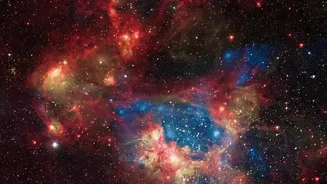
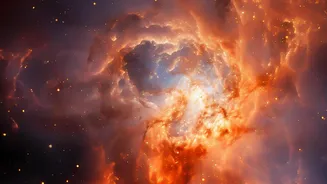
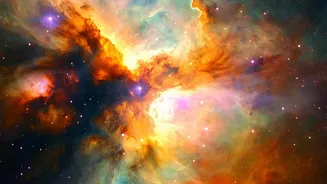
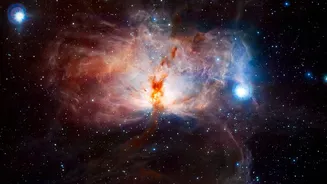
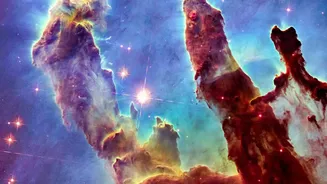
Stellar nurseries are vast, beautiful clouds of gas and dust floating in interstellar space. Regions like the famous Orion Nebula or the Carina Nebula are not just pretty sights; they are active factories where gravity pulls clumps of matter together,
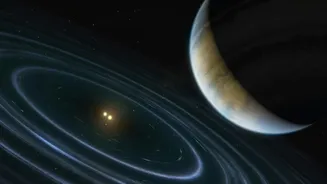
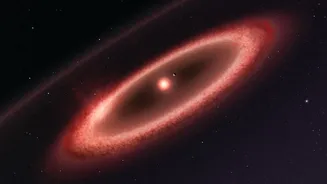
eventually igniting them into new stars. Surrounding these infant stars are flattened, spinning platters of leftover material known as protoplanetary disks. It is within these chaotic, swirling disks—rich with elements like hydrogen, carbon, and dust—that the story of every planet, including our own Earth, begins. For astronomers, studying these nurseries is like having a time machine to witness the first few million years of a solar system's life.
Webb’s Unparalleled Infrared Vision
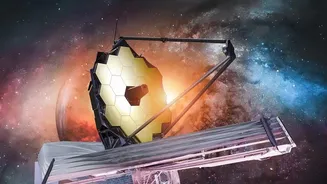
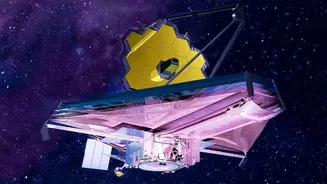
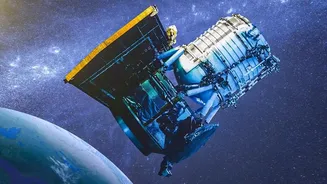
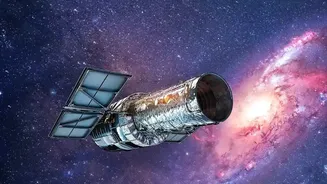
Observing these nurseries has historically been difficult. The very dust that forms planets also creates an opaque veil, hiding the processes from telescopes that see in visible light, like the Hubble. This is where the James Webb Space Telescope's technological prowess comes in. As a powerful infrared observatory, the JWST is designed to detect the faint heat signals that shine through these dense cosmic clouds. This allows it to peer directly into the heart of the action, capturing star and planet formation in real-time. Its incredible sensitivity and high spectral resolution mean it can do more than just take pictures; it can analyze the chemical composition of the material from which new worlds are built, something impossible to do from Earth due to our atmosphere's interference.
A Race Against Time
Recent JWST observations of dozens of young, sun-like stars have revealed that planet formation is a frantic race against the clock. The protoplanetary disk doesn't last forever. Powerful jets and winds, driven by the young star's magnetic fields and radiation, constantly blow the precious gas and dust away into space. This process, known as disk dispersal, sets a strict deadline. Gas giants like Jupiter, for instance, must gather their immense atmospheres before the gaseous reservoir is depleted. One major study of 72 young star systems showed how these dispersal mechanisms evolve, with strong magnetic winds dominating in the earliest stages and high-energy radiation taking over later. Understanding this timeline is crucial to figuring out why some systems form giant planets while others do not.
The Chemical Recipe for a Planet
One of the JWST's primary missions is to take a chemical inventory of these planet-forming disks. By analyzing the light passing through them, scientists can identify the molecular building blocks present. Webb has already delivered groundbreaking results, revealing the richest hydrocarbon chemistry ever seen in a protoplanetary disk around a young star. In one study, it made the first-ever extrasolar detection of ethane and identified other key carbon-bearing molecules like methane and propyne. The presence and ratio of elements like carbon and oxygen, along with water ice, determine the initial chemical conditions for forming planets. These observations show a surprising diversity among disks, suggesting that the recipe for planetary systems can vary significantly from one star to another.
Rewriting the Story of Our Solar System
Every discovery made in a distant stellar nursery provides clues about our own origins. For billions of years, our solar system has been relatively quiet, but in its youth, it was a dynamic and chaotic place, much like the regions Webb is now studying. By observing planets in the process of formation—from dust grains clumping into pebbles, to larger bodies carving paths through their disks—scientists can refine their models of how Earth and its neighbors came to be. The data Webb collects helps explain how rocky worlds like ours acquire water and organic molecules, the essential ingredients for life. These glimpses into cosmic infancy are not just about distant stars; they are a fundamental part of understanding our own place in the universe.