





The Dazzling Celestial Giant
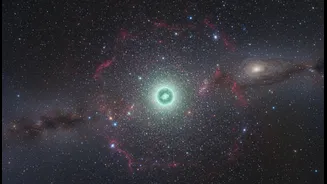
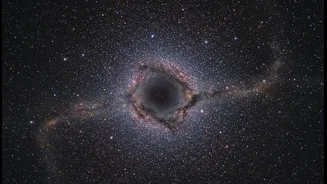
Omega Centauri is a true titan of our galaxy. Located about 17,000 light-years from Earth, it is the biggest and brightest of the 150-or-so globular clusters known to orbit the Milky Way. A single photographic exposure reveals a stunning, densely packed
ball of an estimated 10 million stars, spanning 150 light-years in diameter. For centuries, this spectacular view defined our understanding of it. First catalogued as a star and later as a nebula, it was eventually identified as a globular cluster—a gravitationally bound collection of ancient stars thought to have all formed at the same time from the same cloud of gas. Most globular clusters are simple, containing stars of a uniform age and chemical composition. But Omega Centauri has always been the odd one out, displaying peculiarities that a single snapshot could never explain.
Beyond a Single Moment in Time
The headline-making discoveries about Omega Centauri come from doing what a single image cannot: tracking change over many years. The phrase "look beyond one spectacular snapshot" refers to the painstaking work of astrometry, which measures the precise movements of stars over long periods. By combining more than two decades of archival data from the Hubble Space Telescope with recent, highly precise observations from the James Webb Space Telescope, astronomers can detect the subtle wobble of a star being tugged by an unseen companion. This is like watching a dancer on a vast, dark stage and inferring the presence of their partner just by tracking their movements. This long-term approach, combined with spectroscopy that analyzes starlight to determine a star’s chemical makeup, has peeled back the layers of Omega Centauri's history.
A Cluster of Complexities
This deeper look has revealed two major rewards. First, Omega Centauri is not made of one generation of stars, but several. Unlike typical globular clusters, it contains distinct stellar populations with different ages and chemical makeups. Some stars are much richer in heavy elements than others, suggesting the cluster experienced multiple bursts of star formation over a long period. This complexity led to a fascinating and now widely accepted theory: Omega Centauri is not a true globular cluster at all. Instead, it is likely the surviving core of a dwarf galaxy that was long ago torn apart and partially consumed by the Milky Way. This would explain its enormous mass and its mix of stellar families, which are hallmarks of a galaxy, not a simple cluster.
The Hunt for Missing Black Holes
The second major reward came very recently, in July 2026, with the solution to a long-standing puzzle. Given its size and origin, models predicted Omega Centauri should host about 10,000 stellar-mass black holes, formed from the collapse of massive stars. Yet, for decades, none could be found. Previous searches looking for the tell-tale X-rays from black holes feeding on nearby gas came up empty. But by using the powerful combination of Hubble and Webb data to track star movements, astronomers finally found one. They identified a star locked in a 94-year orbit with an invisible companion that was too massive to be a neutron star. This discovery of the first of potentially thousands of missing black holes confirmed that the patient, long-term observational strategy works. The finding provides crucial data for understanding how black holes form and behave in such densely packed environments.