


Saturn Shines Bright All Night
Throughout August, the magnificent ringed planet Saturn is a standout feature in the night sky. It rises in the east during the evening and remains visible all night, appearing as a steady, bright, golden-hued point of light. Unlike stars, which twinkle,
planets shine with a constant glow, making Saturn relatively easy to identify in the constellation of Pisces. This month provides an excellent opportunity for viewing as the planet heads towards its opposition—its closest and brightest point for the year—in early October. Even a small telescope can reveal its famous rings. For those new to stargazing, look for the waning gibbous Moon passing close to Saturn on the nights of August 30th and 31st, which will make the planet even easier to locate.
A Partial Lunar Eclipse (For Some)
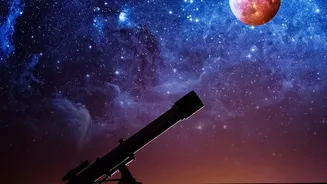
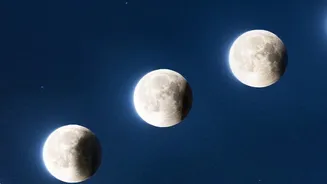
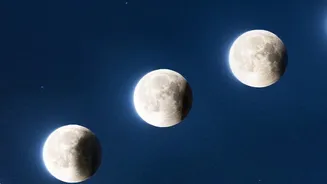
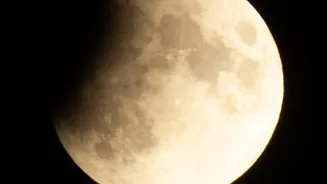
A deep partial lunar eclipse is set to occur on the night of August 27-28. During this event, a significant portion of the Moon will pass through the Earth's darkest shadow, the umbra, which could cause up to 96% of the lunar surface to take on a reddish, copper hue. The moment of greatest eclipse is on August 28 at 09:44 AM IST (04:14 UTC). Unfortunately, because this happens during the daytime for India, the eclipse itself will not be visible from the subcontinent. The event is primarily for viewers in the Americas, Europe, and Africa. However, Indian skywatchers can still enjoy the beauty of the full moon on the nights of August 27 and 28, and can watch live streams of the eclipse from major space agencies online.
The Full 'Sturgeon Moon'
The full moon for August, known as the Sturgeon Moon, will reach its peak illumination on August 28. While the actual eclipse isn't visible from India, the full moon itself will be a beautiful sight. It will appear full and bright in the sky for a few days, from the evening of August 27 to the morning of August 29. The name 'Sturgeon Moon' comes from Native American traditions, linking it to the time of year when the giant sturgeon fish were most easily caught in the Great Lakes. As it graces the sky, it will be located in the constellation of Aquarius. So while we miss the eclipse, there is still a brilliant full moon to appreciate.
Catching the Late Perseids
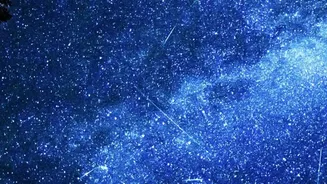
While the peak of the spectacular Perseid meteor shower occurred on August 12-13 under ideal moonless conditions, the show isn't entirely over. The shower remains active until early September. This means that for the rest of August, you still have a chance to spot stray 'shooting stars' from the debris trail of Comet Swift-Tuttle. For the best chance, find a location far from city lights after midnight. Let your eyes adjust to the darkness for about 20-30 minutes and look towards the northeastern sky. While the rate will be much lower than the peak's 50-100 meteors per hour, a patient observer can still be rewarded with a few bright streaks of light.