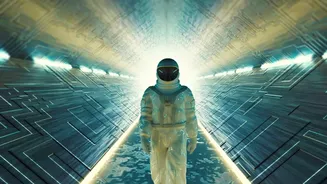










2001: A Space Odyssey (1968)
Stanley Kubrick’s magnum opus wasn't just a movie; it was a cosmic event. Upon its release, audiences were polarized, with some walking out of premieres, baffled by its deliberate pace and abstract narrative. But for those who stayed, it was transformative.
The film trades straightforward plot for a meditative journey through human evolution, guided by a mysterious alien monolith. The leap from a bone-wielding hominid to a star-faring society, all in a single cut, is one of cinema's most audacious edits. Its final act, the psychedelic 'Star Gate' sequence, is a cascade of light and color that abandons conventional storytelling entirely, leaving viewers to interpret its meaning about rebirth and transcendence. It established a new benchmark for cinematic ambition and proved that sci-fi could be profound, philosophical art.
Blade Runner (1982)
Initially a commercial disappointment that confused critics with its slow, noirish pace, Ridley Scott’s vision of a dystopian 2019 Los Angeles found its legacy on home video. 'Blade Runner' stunned audiences not with action, but with atmosphere and existential dread. It asks a simple, yet bottomless question: what separates humans from the artificial 'replicants' they create? The film’s genius lies in its ambiguity. Harrison Ford’s Deckard hunts replicants while grappling with his own potential artificiality, a question the film famously refuses to answer definitively. This wasn't the heroic sci-fi many expected; it was a melancholic poem about memory, identity, and empathy in a world where humanity is a flickering flame.
The Matrix (1999)
Fusing cyberpunk, martial arts, and philosophy, 'The Matrix' was a cultural phenomenon that redefined action cinema for the new millennium. Its premise—that our perceived reality is a computer simulation—wasn't entirely new, but the Wachowskis executed it with such groundbreaking style that it felt like a revelation. The introduction of 'bullet time,' which allowed the camera to move at normal speed while the action slowed, gave audiences a visual language they had never seen before. Beyond the aesthetics, the film tapped into end-of-the-century anxieties about technology and control, turning a philosophical concept (Plato's Allegory of the Cave) into a thrilling blockbuster that made millions question the nature of their own world.
Primer (2004)
Made on a shoestring budget, Shane Carruth's 'Primer' is perhaps the most intellectually demanding time travel film ever made. It makes no concessions for the audience, dropping viewers into the jargon-filled conversations of two engineers who accidentally invent a time machine in their garage. The film's power lies in its refusal to explain itself; the timelines fracture, paradoxes multiply, and characters are replaced by their future selves without clear signposting. Watching it for the first time is a bewildering experience, leaving most viewers completely lost. Yet, this complexity is the point. 'Primer' stuns not with visuals, but with its realistic depiction of a discovery too complex and dangerous for its creators to control, making it a cult classic for those who love a cinematic puzzle.
Inception (2010)
Christopher Nolan took the heist genre and folded it inside a dream, then a dream within that dream. 'Inception' is a blockbuster with the soul of a puzzle box, following a team that enters people's minds to steal or plant ideas. The film's layered reality and complex rules were a mainstream gamble that paid off, fascinating audiences worldwide. But the true stunner was its final, infamous shot: a spinning top that begins to wobble just before the screen cuts to black. Nolan himself recalled sneaking into theaters and hearing the collective 'gasp, groans, frustrations' from the audience. That ambiguous ending, which deliberately withholds the answer of whether the hero is in a dream or reality, sparked over a decade of debate and cemented the film as a modern classic that trusts its audience to live with the question.
Arrival (2016)
While many sci-fi epics focus on invasion, 'Arrival' is about communication. The film follows a linguist, Dr. Louise Banks, tasked with deciphering the language of mysterious alien visitors. The twist that stunned audiences is a masterclass in narrative structure. The flashbacks of Louise's daughter, which open the film and are peppered throughout, are revealed to be flash-forwards. By learning the aliens' language, she begins to perceive time not as a straight line, but all at once. The story isn't about saving the world from aliens; it's about a woman seeing her entire life, including its future tragedy, and choosing to live it anyway. It’s a gut-punch of a reveal that transforms a sci-fi mystery into a profound and heart-wrenching meditation on love, loss, and free will.