


Picking the Perfect Hunting Ground
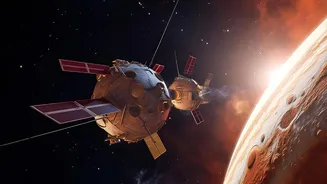
You can't just land a rover anywhere on Mars and hope to get lucky. The search for ancient life begins with choosing the perfect spot. For the Perseverance rover, that location is Jezero Crater. Billions of years ago, this 45-kilometre-wide crater was
a deep lake, fed by a river that built a large, fan-shaped delta. Scientists believe this ancient watery environment could have been habitable for microbial life. The fine-grained clay and carbonate minerals deposited by the river and lake are excellent at preserving delicate structures and chemical signatures, making Jezero Crater one of the most promising places on Mars to find 'biosignatures'—the telltale signs of past life.
A Toolkit for Tiny Clues
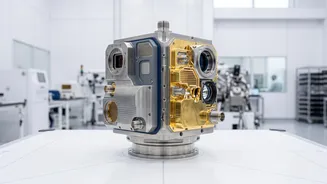
Perseverance is essentially a rolling geology lab, equipped with a suite of sophisticated instruments on its 2-metre-long robotic arm. The key to its fossil-hunting mission is a trio of tools that work together to analyze rocks at a microscopic level. These are SHERLOC, WATSON, and PIXL. Think of them as a high-tech magnifying glass, camera, and chemical scanner all rolled into one. SHERLOC, which stands for Scanning Habitable Environments with Raman & Luminescence for Organics & Chemicals, is the frontline detective. It's designed specifically to find organic molecules and minerals that form in watery environments.
Lasers, X-Rays, and Deep Scans
To find these clues, SHERLOC uses a deep ultraviolet laser to illuminate a small patch of a rock. It then analyzes the light that scatters back to identify the specific minerals and organic compounds present. This technique is so precise it can create 'maps' of organic material across a rock's surface, about the size of a postage stamp. It is assisted by PIXL, the Planetary Instrument for X-ray Lithochemistry. PIXL fires a finely-focused X-ray beam that can pinpoint the elemental composition of features as small as a grain of salt. By mapping elements like carbon, phosphorus, and iron, scientists can spot unusual chemical concentrations that might hint at biological processes.
Getting a Closer Look
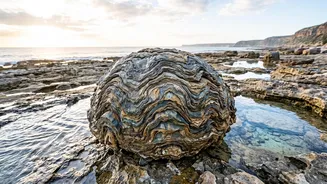
While SHERLOC and PIXL analyze a rock's chemistry, the WATSON camera provides the visual context. Short for Wide Angle Topographic Sensor for Operations and eNgineering, WATSON is a color camera that functions like a geologist's hand lens, taking incredibly detailed, close-up images of rock textures. This is crucial because a biosignature isn't just about chemistry; it can also be a physical structure. Scientists are looking for patterns that resemble stromatolites—layered rock structures created by ancient microbes on Earth. By combining WATSON's high-resolution images with the chemical maps from SHERLOC and PIXL, the science team can see if organic molecules are associated with specific, fossil-like structures.
The Challenge of Fossil Impostors
Finding something that 'looks' like a fossil isn't enough. One of the biggest challenges in the search for life is distinguishing true biosignatures from 'pseudofossils'—structures created by non-biological geological processes that can convincingly mimic life. Chemical reactions, mineral crystallization, and erosion can all create lifelike shapes. For every potential fossil, scientists must rule out all other possible formation methods. This is why findings of organic carbon or intriguing rock textures are always presented with caution. Recent discoveries of rocks with 'leopard spots' and other patterns in Jezero are considered 'potential biosignatures' because while they are consistent with life, a non-biological origin hasn't been completely ruled out.