


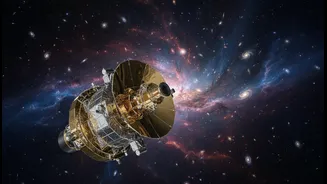


Meet NASA's New Cosmic Surveyor
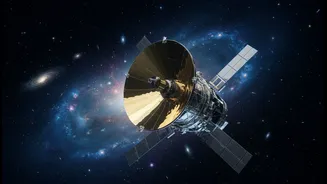
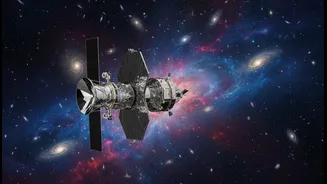
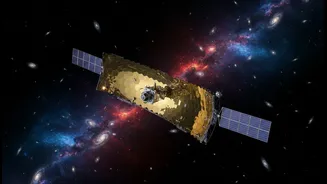
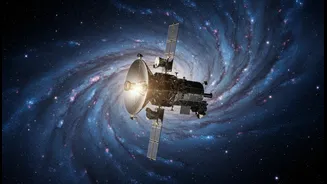
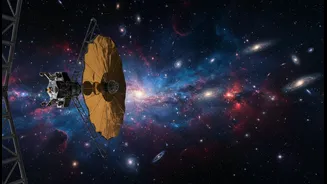
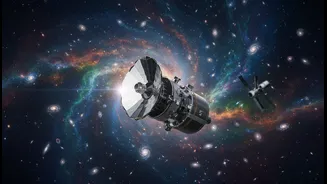
Set to launch on August 30, 2026, the Nancy Grace Roman Space Telescope is the next flagship mission in NASA's quest to unravel the universe's biggest mysteries. Named after Nancy Grace Roman, NASA's first Chief of Astronomy, this observatory is not just
another telescope; it's a cosmic surveyor designed for breathtaking efficiency. While its 2.4-meter primary mirror is the same size as the one on the Hubble Space Telescope, its power lies in its extraordinary field of view. This capability will allow it to map vast regions of the sky with a speed that was previously unimaginable, fundamentally changing how astronomers conduct their research.
The Power of a Panoramic View
The defining feature of the Roman Space Telescope is its Wide Field Instrument (WFI), a 300-megapixel camera that can capture an area of the sky at least 100 times larger than Hubble's infrared camera in a single snapshot. To put that in perspective, while Hubble might capture a detailed portrait of a single star, Roman will capture a panoramic photo of its entire galactic neighborhood. This incredible breadth means that in just one month of observations, Roman could gather data equivalent to what would take Hubble a century to collect. This wide-angle approach doesn't sacrifice detail, as it will maintain a resolution comparable to Hubble's, providing sharp, data-rich images across enormous cosmic vistas.
Solving Cosmic Mysteries: Dark Energy and Exoplanets
Roman's primary mission is twofold: to investigate the nature of dark energy and to discover thousands of exoplanets. Dark energy is the mysterious force believed to be causing the accelerating expansion of the universe. By surveying billions of galaxies, Roman will create a 3D map of the cosmos, allowing scientists to study how the distribution of galaxies has changed over time and measure the effects of dark energy on a grand scale. Simultaneously, the telescope will conduct a massive hunt for exoplanets using a technique called gravitational microlensing. By monitoring hundreds of millions of stars toward the center of the Milky Way, it is expected to find thousands of new worlds, from gas giants to smaller, rocky planets, dramatically expanding our census of planets beyond the solar system.
A Complementary Tool, Not a Replacement
It's important to understand that Roman is not intended to replace observatories like the Hubble or James Webb Space Telescope (JWST), but to work in tandem with them. Think of Roman as the scout and cartographer. Its ability to rapidly survey huge areas of the sky will identify countless new targets of interest—be it distant supernovae, star-shredding black holes, or intriguing exoplanets. Once Roman finds these objects, telescopes like Webb, with its deep-diving, narrow-field capabilities, can perform detailed follow-up observations to analyze their composition and characteristics. This synergy represents a powerful division of labor in modern astronomy, where wide-field surveys provide the context and targets for deep-field studies.
Pushing the Boundaries of Technology
Beyond its primary science goals, Roman is also a platform for technological innovation. It carries a sophisticated Coronagraph Instrument, which is a technology demonstration designed to block the overwhelming glare of a star. This will allow astronomers to directly image faint planets orbiting nearby stars, a feat that is incredibly challenging from Earth. While the coronagraph is primarily a demonstrator, its success will pave the way for future missions specifically designed to find and characterize Earth-like planets in the habitable zones of their stars, bringing us one step closer to answering the question of whether we are alone in the universe.