



Beyond a Simple Diagnosis
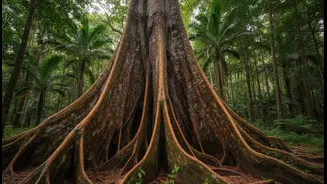
For years, a prevailing theory suggested a straightforward vulnerability in forests: the taller the tree, the greater its risk during a drought. The logic seemed sound. Transporting water hundreds of feet into the sky against gravity is a massive plumbing
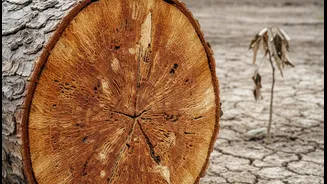
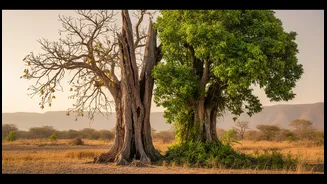
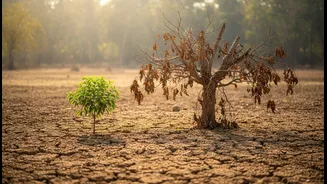
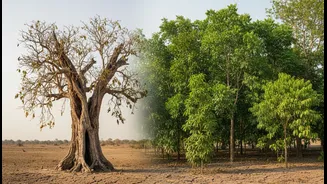
challenge. During a drought, the strain on this system increases dramatically, making tall trees seem like prime candidates for hydraulic failure and death. However, ecologists and conservationists are now embracing a more nuanced view. The survival of a tree in a drought is not a simple story of height. Instead, it is a complex interplay of the tree's species, its individual characteristics, and the specific patch of land it calls home.
The Species Factor
Imagine two people in the desert with the same amount of water. One chugs it all, while the other rations it. Trees have similar strategies. Some species, known as 'isohydric', are cautious water users. They close their leaf pores (stomata) early in a drought to conserve water, effectively avoiding hydraulic failure but risking starvation because they can't photosynthesize. Others, 'anisohydric' species, keep their stomata open longer, gambling on their ability to pull water from the soil. These different strategies mean that a drought that devastates one species might be manageable for its neighbour. Furthermore, traits like wood density, leaf type, and even whether a tree is deciduous (sheds its leaves) or evergreen dramatically alter its drought response.
Location, Location, Location
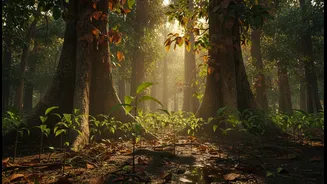
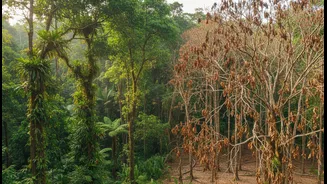
A tree’s immediate environment, or microenvironment, can be just as important as its species. A tree growing in a valley with deep, moist soil has a significant advantage over one on a rocky, sun-beaten slope where water quickly runs off. The density of the surrounding forest also plays a role. While more competition for water can be a negative, a denser canopy can also create a cooler, more humid microclimate that reduces water loss for all trees within it. Recent studies show that these local variations in soil type, topography, and sun exposure can create a patchwork of resilience, where one side of a hill might suffer while the other thrives.
Rethinking the Role of Height
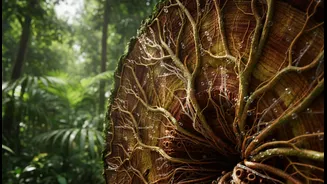
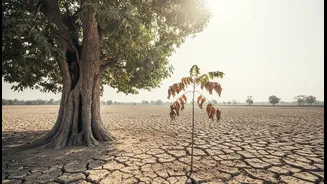
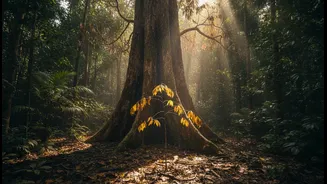
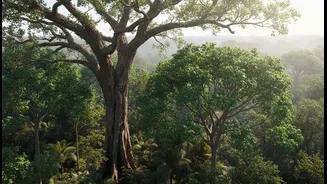
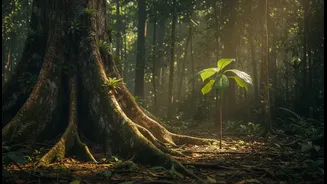
The latest research has also added surprising new details to the tall versus small tree debate. While tall trees do face the immense challenge of pulling water to their crowns, many have evolved sophisticated adaptations to cope. Some species, like the giant dipterocarps of Southeast Asia, develop wider water-conducting vessels (xylem) at their base as they grow, offsetting the increased resistance of height. It turns out they structurally re-engineer their own plumbing over their lifetime. Conversely, while smaller understory trees are more sheltered from the sun and wind, their often shallower root systems can make them highly vulnerable when the topsoil dries out completely. This means neither tall nor small trees are universally safer; their fate depends on how their size interacts with their species' strategy and their location.
What This Means for India's Forests
These findings are critically important for India, home to a vast and diverse range of tropical forests from the Western Ghats to the Northeast. A one-size-fits-all approach to forest management and conservation is clearly inadequate. Protecting these vital ecosystems, which are facing increasing drought and heat stress, will require a granular approach. It means moving beyond broad assumptions and investing in local, on-the-ground studies to understand the specific vulnerabilities of different forests. Conservation efforts must consider the unique mix of species and local conditions in each area to build true resilience against the climatic challenges of the future.