
A Glimpse of Our Sun's Future
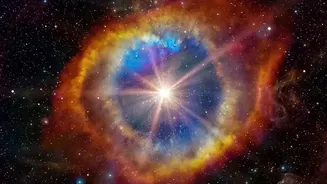
Located about 650 light-years away in the constellation Aquarius, the Helix Nebula is what astronomers call a planetary nebula. The name is a historical misnomer; it has nothing to do with planets. Instead, it’s the beautiful, expanding shell of gas shed
by a star similar to our own sun at the end of its life. After exhausting its nuclear fuel, the star puffed off its outer layers. These layers of gas are now illuminated by the intense ultraviolet radiation from the star's tiny, hot core, a white dwarf, left behind at the center. For astronomers, the Helix Nebula is like a window into the distant future, offering a preview of how our own solar system might end its life billions of years from now.
What Webb's Infrared Eyes Reveal
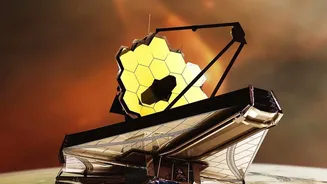
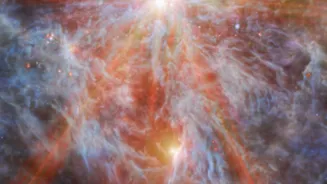
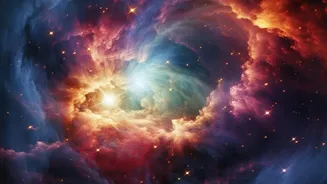
Previous telescopes, including Hubble, have captured breathtaking images of the Helix Nebula, often nicknamed the "Eye of God" for its striking appearance. But the James Webb Space Telescope sees the universe in infrared light, allowing it to pierce through dust and gas to reveal details hidden from view. Webb's new image focuses on thousands of previously unseen structures within the nebula that look like tiny comets, complete with glowing heads and long tails. These are not actual comets, but enormous clumps of molecular gas and dust, known as "cometary knots." Each knot is roughly the size of our solar system and contains a mass comparable to Earth's. Webb's high-resolution view brings these knots into sharp focus, showing them streaming away from the central star.
The Cosmic Recycling Plant in Action
The headline feature of Webb's image is how it visualizes the process of cosmic recycling. The dying star is unleashing fierce stellar winds, and as this fast-moving hot gas slams into the cooler, slower gas shed by the star earlier, it creates the intricate, filamentary structures Webb sees. The cometary knots are dense pockets of material that have survived this chaotic process, but their tails show they are slowly being eroded, or photo-evaporated, by the central star's intense radiation. This entire process is effectively a star returning its material to the vastness of space. All the heavier elements forged inside the star over billions of years—like the carbon, nitrogen, and oxygen essential for life—are cast out into the galaxy. The new image provides the most detailed map yet of this crucial handoff from a dying star to the interstellar medium.
From Stardust to Us
This process isn't just a distant, abstract phenomenon; it's fundamental to our own existence. The elements being dispersed from the Helix Nebula will eventually mix with interstellar gas clouds. Over millions of years, gravity will pull this enriched material together to form the next generation of stars and planets. The iron in our blood, the calcium in our bones, and the carbon in every cell of our bodies were all created inside stars that died long ago and seeded the galaxy with their remains. In this sense, looking at the Helix Nebula is like looking at our own cosmic ancestry. The image is a stunning confirmation that stellar death is not an end, but a vital part of a continuous cycle of renewal that makes new worlds—and perhaps new life—possible.