







The Seasonal Solar Challenge
For a country blessed with abundant sunshine, solar energy is a cornerstone of India's plan to achieve its renewable energy targets, including an ambitious goal of 500 GW of non-fossil fuel capacity by 2030. Yet, this reliance on the sun comes with a significant
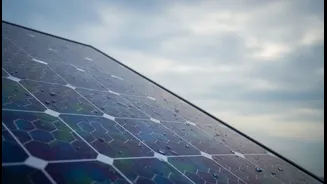
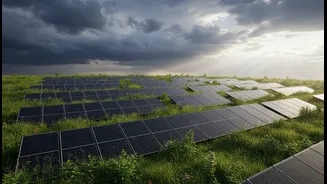
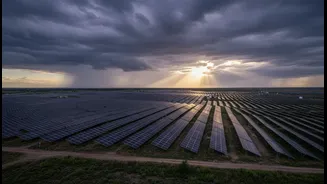
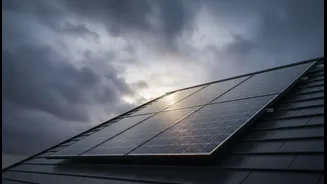
challenge: intermittency. Solar panel output naturally dips on cloudy days and during the shorter days of winter. In India, the effect is particularly pronounced during the monsoon season, when heavy cloud cover can significantly reduce energy generation for months. This variability creates a reliability gap, forcing a continued dependence on fossil fuels to stabilize the power grid when solar output is low and making 24/7 clean power an elusive goal.
A New Kind of Solar Power
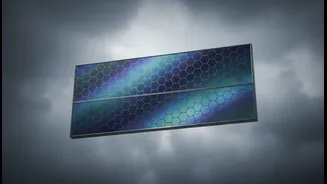
The headline-grabbing solution lies in a new class of devices that fundamentally rethinks how solar power is generated. Instead of just absorbing sunlight, some of the most promising research focuses on thermoradiative cells. Unlike a conventional photovoltaic cell that uses photons from the sun to create electricity, a thermoradiative cell works in reverse. It takes advantage of the temperature difference between the warm panel and its colder surroundings. By radiating heat away as infrared light—for example, towards the cold expanse of the night sky—it can generate a small but meaningful electric current. This concept means that a solar installation could one day produce power not only during the day but also after sunset.
How It Works: Power from Heat and Light
During the day, these next-generation solar installations would function like the high-efficiency panels we see today, perhaps using advanced materials like perovskites stacked on silicon to capture more of the solar spectrum. But the real innovation happens when the sun goes down. The ground and the solar panel itself, having been warmed during the day, are hotter than the clear night sky. A thermoradiative device exploits this temperature gap. It emits this stored heat as invisible infrared light, and in doing so, generates a voltage and a current. While the power produced at night is currently much lower than daytime generation, researchers believe it could eventually reach about a tenth of a conventional panel's output, adding a crucial source of supplementary power.
A Game-Changer for India's Grid
The implications for India are enormous. A solar farm that continues to produce energy after dark, even a small amount, becomes a far more reliable and predictable asset. This 'round-the-clock' capability could reduce the need for expensive battery storage systems, which are currently essential to cover evening energy demand. For a grid strained by fluctuating supply and demand, this added consistency is invaluable. It would make solar power a more stable 'baseload' power source, something traditionally only achievable with fossil fuel or nuclear plants. This enhanced reliability is critical for powering India's growing industrial and commercial sectors, which require consistent energy to operate efficiently and compete globally.
Hurdles on the Horizon
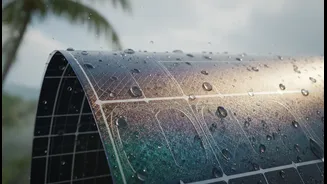
Despite the immense promise, these breakthrough solar sheets are not yet ready for mass deployment on Indian rooftops. The technology is still primarily in the research and development phase at universities and corporate labs. The amount of electricity generated by early prototypes at night is currently only enough to power small devices. Furthermore, some of the advanced materials being used, such as perovskites, still face challenges with long-term durability when exposed to moisture and heat, although new self-healing coatings are being developed to address this. The cost of manufacturing these complex, multi-layered cells at scale remains a significant unknown. Before they can become commercially viable, researchers must prove they can be produced affordably and reliably for decades.