
The Right Tool for the Job
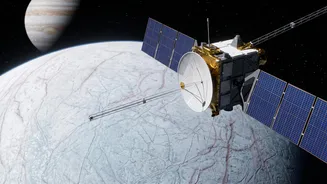
To see through miles of solid ice on a world hundreds of millions of kilometres away, you need a special kind of vision. For the Europa Clipper spacecraft, that tool is an advanced instrument called REASON, which stands for Radar for Europa Assessment
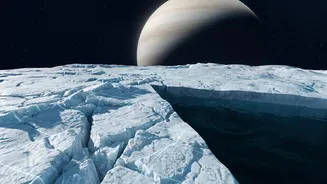
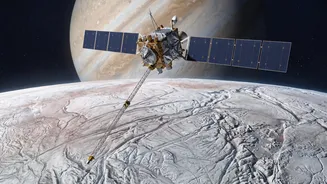
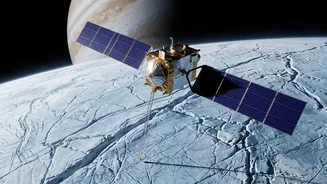
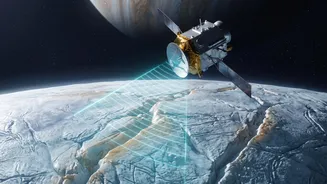
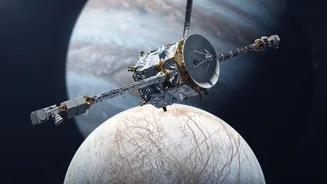
and Sounding: Ocean to Near-surface. It is, in essence, an ice-penetrating radar system designed to do something no spacecraft has done before: create a vertical profile of Europa's icy shell. The instrument consists of several slender antennas extending from the spacecraft's massive solar arrays. These antennas transmit radio waves at two different frequencies, allowing scientists to conduct both shallow and deep soundings of the ice. The primary goal is to find the boundary where the ice ends and the liquid water ocean begins, if it's there.
Sending a Signal Through Deep Ice
The principle behind REASON is similar to technologies used on Earth to study Antarctic ice sheets. The instrument sends radio pulses down toward Europa's surface. Because cold ice is largely transparent to radio waves, the signals travel through it until they hit something different. A change in material—like from solid ice to liquid water, or from ice to pockets of slush, or even from ice to the rocky seafloor below—will cause some of the radio wave's energy to reflect back to the spacecraft. REASON uses both high-frequency (HF) and very-high-frequency (VHF) radio waves. The VHF signals are for detailed, high-resolution mapping of the upper part of the ice shell, while the lower-frequency HF signals are designed to penetrate deeper, potentially all the way to the ocean, which could be up to 30 kilometres down.
Reading the Echoes for Clues
When the radar echoes return to Europa Clipper, the real analysis begins back on Earth. Scientists will measure two key things: the time it took for the signal to return and the strength of that returning signal. The travel time tells them the depth of the feature that reflected it. The strength of the echo, however, reveals the nature of that feature. A reflection from a liquid water boundary is expected to be much stronger and brighter in the data than a reflection from a rock boundary at the base of the ice. By collecting these returns as the spacecraft makes dozens of flybys over different parts of the moon, the science team can gradually build a 3D map of the ice shell's structure. This map will show the ice thickness, reveal its internal layers, and, most importantly, pinpoint the location of any liquid water.
Searching for Habitable Pockets
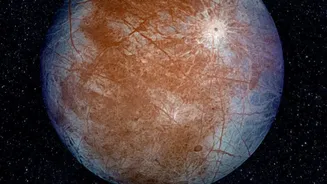
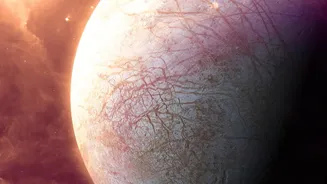
The main prize is confirming and characterizing the vast, global ocean. However, scientists are also hunting for smaller, shallower bodies of water perched within the ice shell itself. Studies of similar features in Greenland's ice sheet suggest that pockets of water can get trapped, refreeze, and deform the ice above, creating features called double ridges that are also seen on Europa's surface. Finding such subsurface lakes would be a monumental discovery. These pockets could be more accessible to future missions and might have a different chemistry from the main ocean. They could also be part of a plumbing system that transports chemicals and potential signs of life between the ocean and the surface. The term "alien ocean" sparks the imagination, but for scientists, habitability begins with finding liquid water, energy, and the right chemical ingredients—all of which Europa might possess.
From Raw Data to a Portrait of an Ocean World
The data returned from REASON will look like a series of vertical lines on a graph, known as a radargram. Each line represents a profile of the ice below the spacecraft at a specific moment. Scientists then assemble these profiles to create a cross-section of the ice shell, similar to a slice of layer cake. By comparing these radargrams with models and data from Earth-based analogues like Lake Vostok in Antarctica, scientists can interpret the layers and reflections. For example, the deformation of internal layers can reveal how the ice has been moving and churning over millennia. This painstaking analysis will not just confirm if an ocean exists, but will help determine its depth, salinity (via other instruments), and how the ice shell interacts with it—key factors in assessing whether Europa is truly a habitable world.