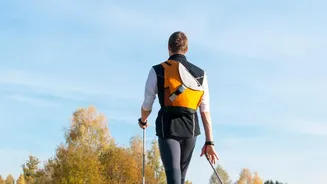




What Is Nordic Walking, Exactly?
Originating in Finland as a summer training method for cross-country skiers, Nordic walking is a full-body exercise that uses specially designed poles to engage the upper body while walking. Unlike trekking or hiking where poles are often used for stability,
Nordic walking poles are used to propel you forward. This transforms a lower-body exercise into a comprehensive workout that activates the muscles in your arms, shoulders, back, and core. Studies show that while regular walking engages about 50% of your body's muscles, Nordic walking can activate up to 90%. This increased muscle engagement means a higher calorie burn—anywhere from 18% to over 60% more than regular walking at the same speed—and a greater cardiovascular challenge without feeling more strenuous.
The Science of Whole-Body Engagement
The secret to Nordic walking's effectiveness lies in its biomechanics. By pressing the poles into the ground with each stride, you actively push your body forward, which not only increases speed and stride length but also engages your upper-body musculature in a significant way. This pushing motion strengthens your triceps, biceps, shoulders, and back muscles. Furthermore, the rotational movement of the torso required for proper poling action strengthens your core abdominal and back muscles, which are crucial for posture and stability. This kind of integrated, full-body movement is what many modern, sedentary lifestyles lack. Desk work often leads to weakened back muscles and tightened chest muscles, contributing to poor posture. Actively strengthening the upper back and shoulders can help counteract this, promoting a more upright and balanced posture.
More Than Just a Bigger Calorie Burn
While burning more calories is a definite perk, the benefits of incorporating upper-body movement extend far beyond weight management. One of the most significant advantages of Nordic walking is that it's a low-impact activity. The poles help distribute your body weight and reduce the stress on your hips, knees, and ankles. This makes it an ideal exercise for older adults, individuals with joint pain, or those recovering from lower-body injuries. Studies have also highlighted its benefits for improving cardiovascular health, enhancing balance and mobility, and even reducing symptoms of depression. Research has shown its effectiveness in rehabilitation for conditions like Parkinson's disease and for post-operative recovery, underscoring its therapeutic potential.
The Shift Toward Everyday, Accessible Fitness
The rising interest in Nordic walking is part of a broader trend toward simpler, more sustainable forms of exercise. In 2026, fitness is less about high-intensity, all-or-nothing workouts and more about finding enjoyable, consistent movement that fits into everyday life. Activities like structured walking, yoga, and low-impact training are gaining popularity because they are accessible, require minimal equipment, and deliver both physical and mental health benefits. The global market for Nordic walking poles is steadily growing, reflecting this increased participation, particularly among adults over 45 who are seeking effective, joint-friendly workouts. This shift acknowledges that the best exercise is the one you can stick with long-term, and the full-body, low-stress nature of Nordic walking makes it a prime candidate for lifelong fitness.