


A World of Possibility
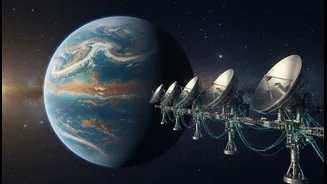
Located 124 light-years away, K2-18b has been a focal point for astronomers since its discovery. It's a 'sub-Neptune'—larger than Earth but smaller than Neptune—and it orbits its red dwarf star within the habitable zone, the region where temperatures
could allow liquid water to exist. Observations from the James Webb Space Telescope (JWST) have made it even more intriguing, detecting methane and carbon dioxide in its atmosphere. This led to the compelling theory that K2-18b could be a 'Hycean' world: a planet with a global water ocean under a thick hydrogen-rich atmosphere, making it a prime candidate for life.
Beyond Life: The Hunt for Technology
The search for extraterrestrial life often focuses on biosignatures, such as gases produced by biological processes. A tentative and still heavily debated detection of dimethyl sulfide (DMS) in 2025, a gas primarily produced by marine life on Earth, heightened excitement around K2-18b. But a parallel and arguably more definitive search targets technosignatures: evidence of technology. Instead of looking for naturally occurring gases, this involves searching for things that are unmistakably artificial, like narrowband radio signals, industrial pollutants, or massive structures. The discovery of a technosignature would be unambiguous proof of an intelligent civilization.
A Multi-Epoch Endeavor
The latest search for technosignatures on K2-18b was a 'multi-epoch' observation, a term that means observing an object at multiple points in time. Researchers used two of the world's most powerful radio telescopes, the Very Large Array (VLA) in New Mexico and MeerKAT in South Africa, to listen for signals over a 33-day period, corresponding to one full orbit of the planet around its star. By observing the planet at different times, astronomers can better filter out interference from Earth and identify if a signal is truly coming from the distant world, as it would shift in frequency due to the planet's movement. This sustained, multi-faceted approach represents a significant step up in the methodical hunt for alien tech.
What the Search Found—And What It Built
The results, published in The Astronomical Journal in July 2026, were definitive: no convincing technosignatures were found. After analyzing millions of potential signals, and filtering out all Earth-based interference and other false positives, the team came up empty-handed. This doesn't mean K2-18b is lifeless, only that it isn't broadcasting detectable radio signals within the frequencies that were scanned. However, the true breakthrough wasn't what they found, but what they built. The project developed an advanced, powerful new software pipeline for sifting through massive volumes of data to isolate potential signals. This new tool significantly speeds up the process and makes future searches for technosignatures much more effective and efficient.
The Future of Listening
While the silence from K2-18b might seem anticlimactic, the search was a major success for the Search for Extraterrestrial Intelligence (SETI). It established a new and rigorous framework for conducting and analyzing technosignature searches. It also allowed scientists to set an 'upper limit' on the power of any potential transmitters on the planet, concluding that nothing as strong as our former Arecibo radio telescope is operating there. As new, even more powerful observatories like the Square Kilometer Array come online, the methods pioneered in the K2-18b search will be invaluable. We may not have heard anything this time, but we are getting substantially better at listening.