



What Exactly Happened?
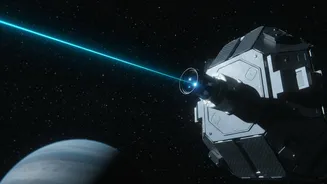
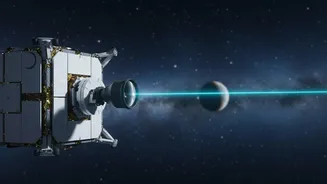
In a historic first, a NASA technology demonstration has beamed an ultra-high-definition video from deep space to Earth. The 15-second video, which charmingly features a cat named Taters chasing a laser dot, was transmitted from the Psyche spacecraft
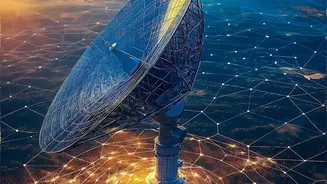
when it was approximately 19 million miles (31 million kilometers) away. That’s about 80 times the distance between the Earth and the Moon. The signal, encoded in a near-infrared laser, took 101 seconds to travel to the Hale Telescope at Caltech's Palomar Observatory in California. This demonstration, known as the Deep Space Optical Communications (DSOC) experiment, achieved a maximum data transfer rate of 267 megabits per second (Mbps), a speed comparable to terrestrial broadband internet.
Broadband for Space: The Old Way vs. The New
For decades, space missions have relied on radio frequency (RF) communications to send and receive data. While reliable, RF technology is reaching its limit. As scientific instruments become more sophisticated and gather more complex data, the need for higher bandwidth has become critical. Think of it as the difference between old dial-up internet and modern fiber-optic broadband. RF communication is like trying to download a high-definition movie over a slow, decades-old connection — it takes an eternity. Laser communications, or optical communications, use light to carry information, offering data rates 10 to 100 times greater than the best RF systems currently in use by deep space missions. This increase in bandwidth means missions can send back significantly more data, including high-resolution images and video, in a fraction of the time.
How Laser Communication Works
The principle behind deep space laser communication is both elegant and incredibly challenging. The DSOC system on the Psyche spacecraft features a flight laser transceiver that encodes data into the photons of a near-infrared laser beam. This tightly focused beam is then aimed with pinpoint accuracy at a ground station on Earth millions of miles away. The precision required is immense; it's like trying to hit a moving dime from a mile away. To help with targeting, a powerful uplink laser beacon from Earth is sent to the spacecraft, which helps the transceiver lock on and send its data-carrying beam back. At the receiving end, a special telescope equipped with an array of superconducting detectors is used to catch the faint photons and decode the information they carry.
A Game-Changer for Future Exploration
This successful test is far more than just a technical demonstration; it is a foundational step for the future of space exploration. For robotic missions, it means being able to send back vast quantities of scientific data, leading to more discoveries about our solar system. But the most significant impact may be on human exploration. For humanity's next giant leap—sending astronauts to Mars—high-bandwidth communication is not a luxury, it's a necessity. It would allow for high-definition video calls with astronauts, the rapid transmission of large mission-critical data files, and even live streaming from the Martian surface. This technology essentially lays the communications groundwork for a sustained human presence on the Moon and eventually Mars.
What Are the Next Steps?
The Taters video was just the beginning. The DSOC experiment will continue to test the limits of the technology as the Psyche spacecraft travels farther from Earth on its way to the main asteroid belt. In subsequent tests, the system has already transmitted data from over 140 million miles away, proving its capability over even greater distances, though at reduced speeds as expected. The ultimate goal is to refine and integrate this technology into future missions across NASA. The upcoming Artemis II mission, which will carry astronauts around the Moon, is slated to feature its own optical communications system. As the technology matures, laser communications will likely work alongside radio frequency systems, providing a robust, multi-channel communications network for exploring the cosmos.