



A Sugar Called Erythrulose
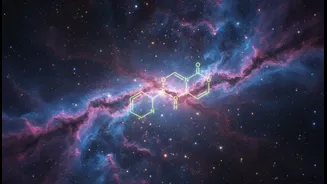
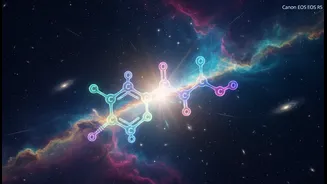
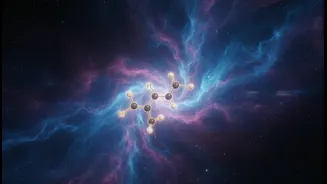
The molecule of the hour is erythrulose, a four-carbon sugar. While you won't be stirring it into your coffee, it's a significant find. On Earth, it occurs in things like red raspberries and is even used in some sunless tanning products. In the context
of space, however, its presence is far more profound. An international team of astronomers detected erythrulose for the first time ever in the interstellar medium – the diffuse matter that exists between stars. The discovery was made by pointing powerful radio telescopes in Spain towards a massive, chemically rich molecular cloud named G+0.693−0.027, located near the centre of our Milky Way galaxy, about 26,745 light-years away. By analysing the faint radio signals, scientists matched the unique spectral fingerprint of erythrulose, confirming its existence in this stellar nursery.
The Prebiotic Connection
This discovery is exciting because sugars are crucial prebiotic molecules. This means they are chemical precursors, or building blocks, for life as we know it. Sugars form the structural backbone of RNA and DNA, the molecules that carry genetic instructions, and they are also vital for metabolic processes. While scientists have previously found sugars like ribose and glucose on meteorites that have landed on Earth, this is the first time a true sugar has been directly detected in the void between stars. This suggests that such crucial ingredients don't need a planet to form; they can be cooked up in deep space. The discovery pushes the potential origins of life's building blocks further back in time, into the very clouds from which stars and planets are born.
A Surprising Recipe for Cosmic Sugar
One of the most surprising parts of the discovery is how abundant erythrulose seems to be. Researchers found it is at least eight times more plentiful than simpler, three-carbon sugars were expected to be. This challenges the long-held theory that complex molecules in space form incrementally, by adding one carbon atom at a time. Instead, the evidence suggests erythrulose forms more efficiently from the combination of simpler two-carbon molecules, like glycolaldehyde, on the icy surfaces of interstellar dust grains. These tiny dust particles act as cosmic meeting points, where basic chemicals can react and build into more complex structures like erythrulose.
From Interstellar Clouds to Early Earth
So how does a sugar molecule formed thousands of light-years away impact life on Earth? The leading theory is delivery by comets and asteroids. Scientists believe that during the Late Heavy Bombardment, a period roughly 4 billion years ago, Earth was pummelled by cosmic objects. It's hypothesised that millions of tonnes of molecules like erythrulose could have been delivered to our young, sterile planet during this time. These extraterrestrial ingredients would have enriched the 'prebiotic soup' in Earth's early oceans, providing a ready-made toolkit for the complex chemistry that eventually led to the first life. In aqueous environments, erythrulose can also transform into other important molecules, including threose, which is considered a possible evolutionary predecessor to RNA.