



The Fiery Problem of Coming Home
Any object entering a planet's atmosphere faces a brutal reality. Moving at thousands of miles per hour, the spacecraft compresses the air in front of it, creating immense friction and temperatures that can exceed those on the surface of the sun. This
intense heating is why atmospheric re-entry is one of the most dangerous phases of any space mission. Traditionally, engineers have relied on rigid, ablative heat shields. These function by having layers of material that burn away in a controlled manner, carrying the extreme heat away from the precious cargo or crew inside. While effective, this approach has a significant limitation: size. A rigid heat shield cannot be any larger than the diameter of the rocket fairing that carries it into space. This constraint directly limits the size and weight of what we can safely land, a major hurdle for ambitious future missions.
Thinking Outside the Rocket Fairing
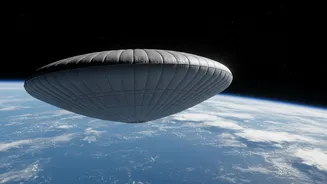
This is where the game-changing idea of an inflatable heat shield comes in. Known technically as a Hypersonic Inflatable Aerodynamic Decelerator, or HIAD, the concept is to use a deployable shield that can be packed tightly for launch and then inflated in space just before re-entry. By inflating to a diameter much larger than the rocket fairing would allow, the HIAD creates significantly more drag. This increased surface area allows the spacecraft to start slowing down much higher in the atmosphere, where the air is thinner. This process is more gradual, leading to lower peak heating and mechanical stress on the vehicle. Essentially, it's like using a giant, high-tech parachute at hypersonic speeds, enabling the landing of heavier payloads at higher-altitude locations, which was previously impossible.
Built to Withstand the Inferno
The obvious question is how something inflatable can survive such an extreme environment. The answer lies in cutting-edge materials science. The inflatable structure itself is composed of stacked rings, or tori, woven from synthetic polymers that are, pound for pound, many times stronger than steel. This provides the structural rigidity when inflated. This structure is then covered by a flexible thermal protection system. This outer layer is a high-tech fabric designed to withstand the initial shock of the heat, while layers of advanced insulation like carbon felt and aerogels prevent that heat from reaching the inflatable structure itself. A final gas barrier ensures no hot atmospheric gases can penetrate the system. The result is a system that is pliable enough to be folded away, yet strong and resilient enough to protect a spacecraft during its fiery descent.
A Landmark Success: The LOFTID Mission
This technology is not just theoretical. NASA successfully demonstrated its capability with the Low-Earth Orbit Flight Test of an Inflatable Decelerator (LOFTID) mission. Launched as a secondary payload, the LOFTID vehicle was deployed in orbit, inflated its six-meter diameter heat shield, and re-entered Earth's atmosphere at more than 18,000 miles per hour. It successfully endured the punishing re-entry, slowed to a safe speed, deployed its parachutes, and was recovered from the Pacific Ocean in excellent condition. The mission was declared a huge success, proving that the HIAD technology was ready for operational use. Data gathered from sensors on the shield confirmed that it performed as designed, protecting its core structure from the intense heat and aerodynamic forces.
Unlocking the Future of Space Exploration
The success of inflatable heat shields opens up a new era of possibilities. For Mars, it's a critical enabling technology for landing the heavy payloads required for human missions, including habitats, life support systems, and ascent vehicles. It also allows for landings in the Martian highlands, which are scientifically interesting but have been inaccessible because the thin atmosphere provides little braking for conventional landers. The applications extend beyond Mars. This technology could be used for missions to Venus or Saturn's moon Titan, both of which have thick atmospheres. Closer to home, it could enable the cost-effective return of large components from low-Earth orbit, such as reusable rocket stages or even materials manufactured in space, contributing to a more sustainable space economy.