
Venus Shines Brightest
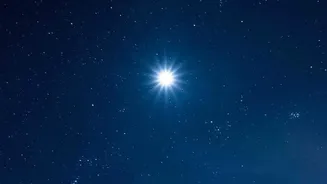
The planet Venus will be a stunning sight throughout September, earning its title as the 'Evening Star'. On September 22, it reaches its peak brightness for the year, blazing at a brilliant magnitude of -4.8. Look for this spectacular beacon low in the west-southwestern
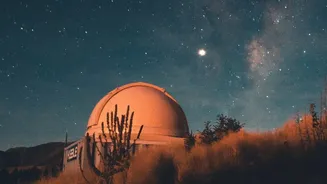
sky shortly after sunset. Due to its position, a viewing spot with a clear and unobstructed horizon is highly recommended. Even in light-polluted cities, its sheer brightness should make it an unmissable target. The month also begins with Venus having a close encounter with Spica, the brightest star in the Virgo constellation, on September 1 and 2.
A Dance of Moon and Planets
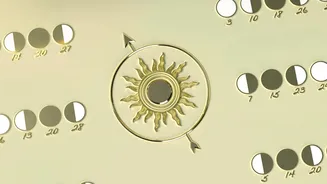
September offers a wonderful series of close encounters between the Moon and several planets. For observers in India, these conjunctions provide excellent photo opportunities and a great way to identify planets. The show begins on September 6 and 7, when the waning crescent Moon passes close to a faint Mars in the pre-dawn eastern sky. Then, on September 8, the Moon meets Jupiter. A particularly beautiful event occurs on September 14, when a slender crescent Moon has a close encounter with the dazzling Venus, an event visible from much of Asia. Keep your eyes on the sky from September 6 to 14 as the Moon makes its monthly journey past Mars, Jupiter, Mercury, and Venus.
The Autumnal Equinox Arrives
The official start of autumn in the Northern Hemisphere, the September Equinox, occurs on September 23 at 5:35 AM IST. On this day, the Sun shines directly over the Earth's equator, and the length of day and night are nearly equal across the globe. For stargazers, this is a welcome sign. After the equinox, nights become progressively longer than days, offering more time for observing the cosmos. It's a moment of balance, traditionally associated with harvests and a transition to cooler weather, marking a turning point in the astronomical calendar.
A Double Feature: Neptune and the Harvest Moon
September 26 brings two major events on the same night. The first is for telescope users: the distant ice giant Neptune reaches opposition. This is the point in its orbit where Earth passes directly between Neptune and the Sun, making the planet appear its biggest and brightest for the year. However, due to its extreme distance, it will only be visible as a small blue-green dot through a telescope. For naked-eye observers, the main event is the Full Harvest Moon, which also peaks on September 26. The Harvest Moon is the name given to the full moon that occurs closest to the autumnal equinox. For several evenings around this date, the Moon rises at nearly the same time, providing bright moonlight that historically helped farmers gather their crops.
Minor Meteor Showers
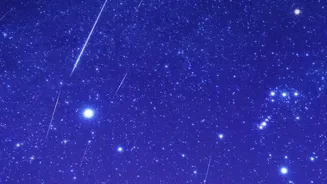
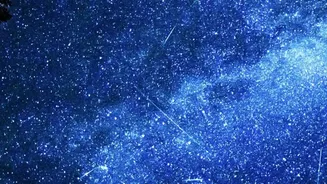
While September doesn't feature any major meteor showers like the August Perseids, there are a few minor showers active. The September Epsilon Perseids will peak around September 9. This shower produces a modest rate of about 5 to 8 meteors per hour at its peak, but viewing conditions are excellent as the peak coincides with the new moon phase. The Aurigid meteor shower peaks on September 1, but a bright moon will likely interfere with viewing. These showers are best seen from a dark location, far from city lights, after midnight when the radiant point is high in the sky.