


Our Universe's Standard Biography
The prevailing story of our cosmos is known as the Lambda-CDM model. It's the scientific consensus, and it tells us that everything began with the Big Bang about 13.8 billion years ago. This age is not a guess; it's calculated from observations of the cosmic
microwave background—the faint, leftover glow of the Big Bang—and the rate at which the universe is expanding. In this model, the universe is composed of not only the stars and planets we can see, but also vast quantities of mysterious 'dark matter' providing extra gravity and 'dark energy' driving cosmic expansion. This framework has been incredibly successful, explaining most of what we observe. But some recent discoveries are beginning to challenge its completeness.
The 'Impossible Early Galaxy' Problem
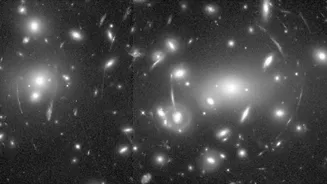
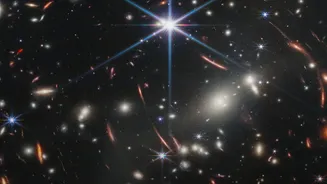
The James Webb Space Telescope (JWST) was built to peer deeper into cosmic history than ever before. In doing so, it has found something puzzling: galaxies in the very distant, early universe that appear shockingly mature. These galaxies are large, well-formed, and surprisingly bright. According to the standard 13.8-billion-year timeline, some of these galaxies would have had only a few hundred million years to form, which many astronomers believe is not enough time to grow to the size and complexity observed. This has been dubbed the 'impossible early galaxy' problem, creating a tension that has sent some scientists searching for alternative explanations.
An Alternate Theory Emerges
Enter a new, and controversial, idea from University of Ottawa physicist Rajendra Gupta and his colleagues. Their model, known as CCC+TL, proposes a radically different cosmic history. The name stands for 'Covarying Coupling Constants plus Tired Light'. This theory combines two concepts. First, 'tired light' (TL), an old hypothesis that suggests light loses energy as it travels across cosmic distances, making distant objects appear redder and thus further away than they really are. Second, 'covarying coupling constants' (CCC), the idea that the fundamental forces of nature might not be constant and could have evolved over time. By blending these ideas, Gupta suggests the universe could be much older than we think.
How an Older Universe Solves the Puzzle
The CCC+TL model arrives at an age of 26.7 billion years. This expanded timeline neatly solves the 'impossible galaxy' problem by giving those ancient galaxies billions, not millions, of years to develop. In this scenario, the redshift we observe from distant galaxies isn't just due to the expansion of space (the standard view), but also because the light itself has 'aged' on its journey. The model also proposes that changes in the constants governing physical forces could explain the observed motions of galaxies without needing to invoke the existence of dark matter. It's a comprehensive rethink of cosmology that, according to its proponents, matches several key observations without the need for dark matter or dark energy.
A Healthy Scientific Debate
It is crucial to understand that the CCC+TL model is not the new consensus. It is a hypothesis that sits outside the scientific mainstream. The 'tired light' concept, in its original form, was largely discredited decades ago because it failed to explain key observations like the time dilation of supernovae and the precise spectrum of the cosmic microwave background. Proponents of this new, hybrid model argue that combining it with evolving constants resolves these past failures. The wider scientific community remains skeptical, as the standard Lambda-CDM model still explains a vast range of cosmological data with great success. However, science advances by testing new ideas against observation. Whether this theory is ultimately proven right or wrong, it represents a fascinating example of how scientists work to resolve inconsistencies and push the boundaries of human knowledge.