




A New Eye on the Cosmos
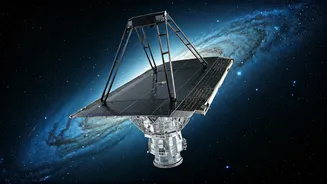
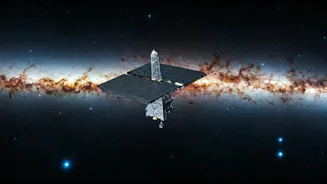
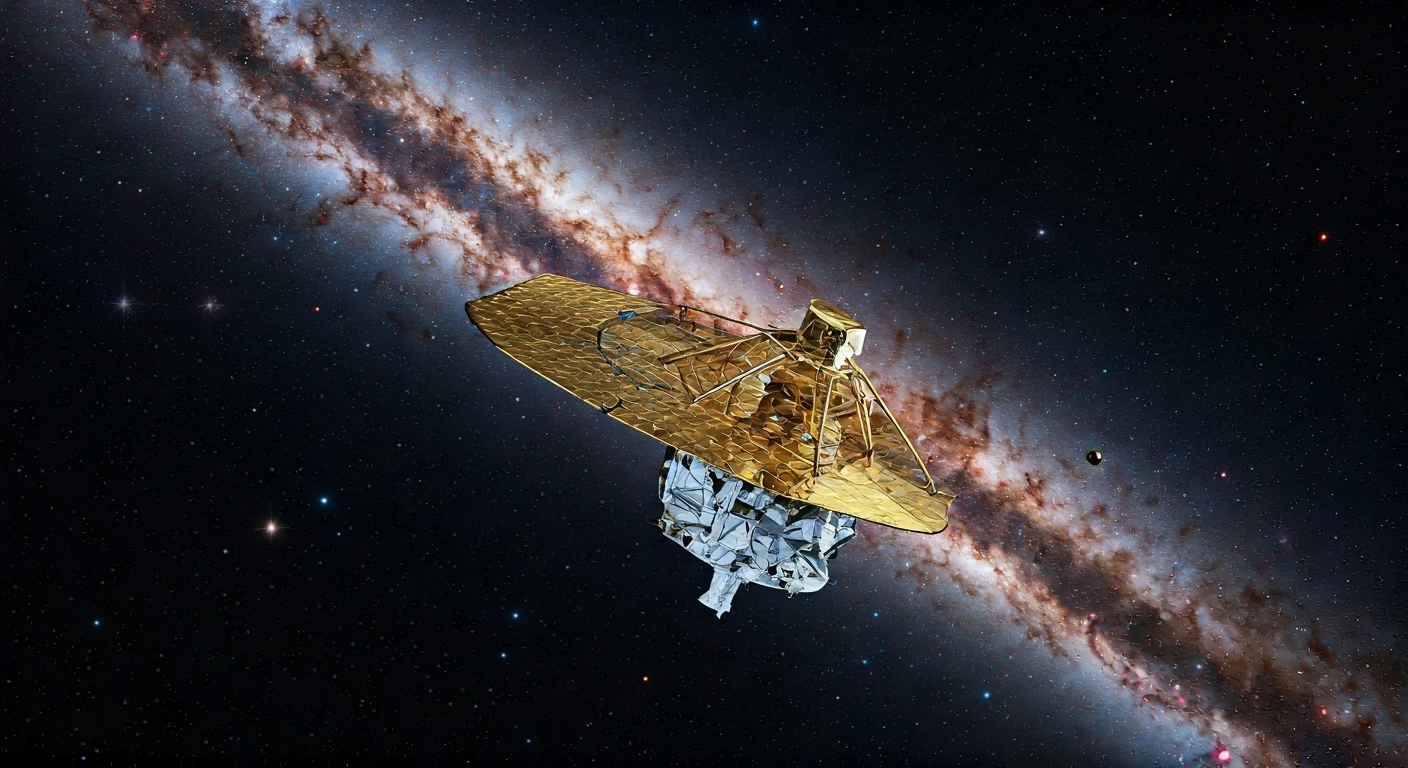
Scheduled to launch as early as August 30, 2026, the Nancy Grace Roman Space Telescope is NASA's next flagship astrophysics mission. [4, 13] Named after NASA's first chief of astronomy, Nancy Grace Roman, who is known as the 'mother of Hubble', this observatory
is designed to be a discovery machine. [2, 8] While Hubble and Webb are like microscopes, designed for deep, narrow looks at specific cosmic targets, Roman is like a panoramic camera. It has the same size primary mirror as Hubble (2.4 meters) but features a groundbreaking instrument that gives it a field of view at least 100 times larger. [2, 5, 23] This means it can map the sky up to 1,000 times faster than Hubble, creating vast cosmic maps with the same sharp resolution. [14, 24] It recently arrived at Kennedy Space Center in Florida to begin final preparations for its launch aboard a SpaceX Falcon Heavy rocket. [3, 13]
The Biggest Picture Ever
Roman's greatest strength is its incredible field of view. While Webb and Hubble see a tiny patch of sky with exquisite detail, Roman will capture huge swathes in a single shot. [20, 23] Think of it this way: if looking through Hubble is like peering through a pinhole, looking through Roman is like opening the curtains on a giant bay window. This capability is essential for its two primary goals: understanding the nature of dark energy and completing a census of exoplanets. [2] By surveying billions of galaxies and stars, Roman will generate an unprecedented amount of data, creating the first wide-field infrared maps of the universe from space. [9, 14] This 'big picture' view is crucial for studying the large-scale structure of the cosmos and seeing how it has evolved. [20]
Hunting the Ghost of the Cosmos: Dark Energy
One of the biggest mysteries in physics is why the expansion of the universe is accelerating. The leading explanation is an invisible pressure called dark energy, believed to make up about 68% of the cosmos. [22] Roman will investigate dark energy in two major ways. First, it will use a technique called weak gravitational lensing, measuring how the light from distant galaxies is subtly distorted by the gravity of intervening dark matter. [12, 16] By mapping these distortions across millions of galaxies, scientists can map the distribution of dark matter and infer the influence of dark energy over cosmic history. [16, 22] Second, it will hunt for thousands of Type Ia supernovae—exploding stars with a known intrinsic brightness—which act as cosmic mile markers to precisely measure the expansion rate of the universe over time. [17, 22]
A Census of Alien Worlds
Roman is also set to revolutionize the search for planets outside our solar system. Its primary planet-hunting technique is called gravitational microlensing. [7, 19] This method relies on a trick of general relativity: when a star with a planet passes in front of a more distant star, its gravity acts like a lens, briefly magnifying the background starlight. [11] The planet itself causes a smaller, secondary blip in the light. [15] This technique is sensitive enough to find planets much farther away and with smaller masses than other methods, including Earth-mass planets and even 'rogue' planets that don't orbit a star. [6, 11] While other methods have found thousands of mostly large planets close to their stars, Roman's microlensing survey is expected to find thousands more, creating a statistical census of planets from the habitable zone outwards. [7, 11]
More Than Just Two Goals
Beyond its two main surveys, Roman will be a versatile tool for all of astronomy. The telescope is also equipped with a Coronagraph Instrument, a technology demonstrator designed to block the glare from a star to directly image the much fainter planets orbiting it. [5, 8] This technology could provide images up to a thousand times more detailed than previously possible, allowing for direct characterization of exoplanets. [7] The data from all of Roman's surveys will be made publicly available, providing a treasure trove for scientists to study everything from asteroids in our solar system to the most distant galaxies, ensuring its impact is felt across the entire field of astrophysics for years to come. [9, 14]