



Reading an Alien Atmosphere
The real breakthrough isn’t just finding water; it’s being able to read an entire alien atmosphere hundreds of light-years away. Scientists achieve this using a technique called transit spectroscopy. When an exoplanet passes in front of its host star
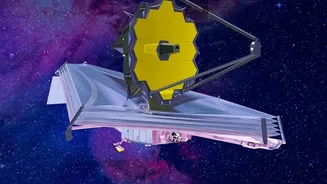
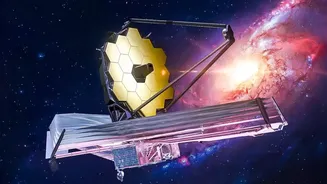
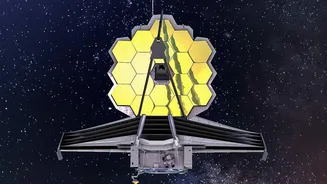
from our perspective, a tiny fraction of the starlight filters through the planet's atmosphere. The JWST's incredibly sensitive instruments, like the Near-Infrared Spectrograph (NIRSpec), capture this light. Different molecules in the atmosphere absorb specific wavelengths, or colors, of light. This creates a unique chemical fingerprint, or spectrum, that tells researchers what the atmosphere is made of. Water, methane, and carbon dioxide each leave a distinct signature.
Water's Telltale Infrared Signature
Water vapor is particularly visible to Webb's powerful infrared eyes. Molecules in an atmosphere absorb light at very specific frequencies, and water has strong absorption features in the infrared part of the spectrum that JWST is optimized to see. When scientists analyze the starlight that has passed through an exoplanet's atmosphere, they look for dips in brightness at these specific infrared wavelengths. If they see the characteristic pattern of absorption that matches water, they can confirm its presence. Before Webb, telescopes like Hubble could get hints of water, but they often struggled with hazy or cloudy atmospheres that would obscure the signal. JWST's precision allows it to peer through these layers and get a much clearer picture.
More Than Just H2O
Detecting water is a headline-grabbing achievement, but it's the combination of elements that tells the full story. For instance, on the exoplanet WASP-107b, Webb found not just water vapor but also sulfur dioxide and clouds made of silicate sand. The surprising absence of methane on that world suggests its interior is very warm. On another planet, WASP-39 b, Webb detected sulfur dioxide that could only have been created by photochemical reactions—the result of the star's high-energy light interacting with the atmosphere, much like how ozone is formed on Earth. These combinations of gases provide clues about the planet's temperature, pressure, weather, and even its formation history.
Clues About a Planet’s Past
JWST can even analyze different variants of water, which helps scientists understand how a planet may have formed and evolved. A recent study of WASP-39 b found evidence of "semi-heavy water," a version of H2O where one hydrogen atom is replaced by a heavier isotope called deuterium. A higher-than-expected ratio of semi-heavy water could suggest the planet formed much farther out in its solar system, in a colder region, and later migrated inward. Alternatively, it might mean the planet’s intense heat has caused lighter water molecules to escape into space over billions of years, leaving the heavier version behind. This kind of forensic science was impossible before JWST, and it opens a new window into planetary evolution.
The Search for Habitable Worlds
Ultimately, analyzing atmospheric water is a crucial piece of a much larger puzzle: the search for habitable worlds. A planet like K2-18 b, located about 120 light-years away, has shown strong evidence of water vapor and other carbon-bearing molecules. This has made it a prime candidate for a "Hycean" world—a hypothetical type of planet with a water ocean under a hydrogen-rich atmosphere. While these worlds aren't Earth-like, scientists believe they could potentially support microbial life. It is important to note that detecting water vapor does not mean liquid oceans or life have been found. Instead, it provides a list of ingredients. By understanding the full chemical inventory, temperature, and pressure, scientists can start to assess whether a planet has the right conditions for life as we know it to exist.