







Ready Your Ride for Rain
Before you even think about routes, your vehicle needs a thorough monsoon check-up. The demanding conditions of the Ghats—slippery roads, reduced visibility, and potential waterlogging—mean your car must be in top form. Start with the most critical components
for wet-weather driving. Inspect your tyres for tread depth; anything less than 3mm is risky, as it increases the chances of aquaplaning. Ensure your windscreen wipers are not leaving streaks or making noise; it's often best to replace them before the season starts. Top up your washer fluid to effectively clear mud and grime. Test all your lights—headlights, tail-lamps, indicators, and especially fog lamps. Good visibility is crucial, but always use low beams in heavy rain or fog to avoid blinding oncoming traffic. Finally, have your brakes inspected. Wet roads can significantly increase stopping distances, so ensure your brake pads have enough life and the system is responsive.
Packing for the Unexpected
Your standard road trip kit needs a few monsoon-specific additions. Beyond clothes, pack an emergency kit that can handle unforeseen delays. This should include a powerful torch, a tow rope, jumper cables, and a puncture repair kit. Given the possibility of road closures or getting stranded, carry extra drinking water and non-perishable snacks. A fully charged power bank is non-negotiable, as you may lose signal and need your phone for offline maps. Speaking of which, download offline maps for your entire route. Network connectivity is notoriously patchy in many parts of the Western Ghats, and you cannot rely solely on live navigation. Also include a comprehensive first-aid kit, waterproof bags for electronics, and rain gear for everyone in the car.
Choosing Your Route Wisely
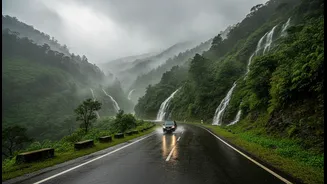
The Western Ghats offer countless scenic drives, but not all are advisable during peak monsoon. Popular routes like Mumbai to Goa, Bangalore to Coorg, or Kochi to Munnar are spectacular but come with caveats. Ghat sections such as Amboli, Tamhini, and Malshej are famous for waterfalls but also prone to fog and landslides. Recent events have highlighted the fragility of areas like Wayanad in Kerala and parts of the Nilgiris, which have seen devastating landslides. Before starting your journey, and each morning of your trip, check for real-time updates on road conditions and weather alerts from local authorities and traffic apps. Be prepared to change your plans. It is always safer to take a longer, more stable route than a scenic shortcut through a known landslide-prone area, especially after heavy overnight rain.
Navigating On-Road Hazards
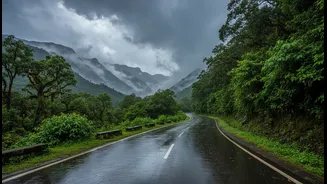
Driving in the Ghats during monsoon is a test of defensive driving. The golden rule is to reduce your speed significantly, by at least 25-30% of your normal pace on dry roads. Double the safe following distance between you and the vehicle ahead. On winding ghat roads, honk at every hairpin bend to alert oncoming traffic and stick to your lane. Never overtake on a blind curve. One of the biggest dangers is waterlogged roads. As a rule, if you cannot gauge the depth of the water or if it is above the center of your wheels, do not attempt to cross. If you must, engage first gear and maintain high engine RPMs to prevent water from entering the exhaust pipe. If your car stalls in water, do not try to restart the engine, as this can cause catastrophic damage known as hydrostatic lock. Be equally wary of small streams of water flowing across the road, as they can carry debris or signal a larger landslide developing uphill.
The Uphill-Downhill Rule
Ghat driving has its own etiquette, and the most important rule concerns right of way. The vehicle climbing uphill always has the right of way. This is because it is much harder for a driver to restart from a standstill on a steep, slippery incline. If you are driving downhill and encounter a vehicle coming up, pull over to the side and let them pass. When driving downhill, use engine braking by shifting to a lower gear (second or third) rather than constantly riding your brakes. This prevents your brakes from overheating and failing, a very real danger on long descents. Never coast downhill in neutral or with the clutch depressed; you lose crucial control over the vehicle.