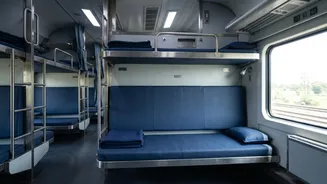







The First Step: Basic Berth Preference
The most straightforward tool at your disposal is the ‘Berth Preference’ dropdown menu on the IRCTC website and app. When filling in passenger details, you can select ‘Lower’ as your choice. While this may seem obvious, many users leave it set to ‘No
Preference,’ which leaves the allocation entirely up to the system's algorithm. Selecting ‘Lower’ explicitly signals your request. It is crucial to understand that this is treated as a preference, not a guarantee. The system's ability to honour this request depends heavily on how many lower berths are available at the moment you book. For the best results, always set this preference, especially if you are booking tickets well in advance when more berths are still unassigned.
The Automatic Setting: Leveraging Quotas
Indian Railways has an automated system that prioritises lower berths for certain passengers. This is known as the Lower Berth Quota or Senior Citizen Quota. This ‘setting’ is activated automatically when you enter the correct age for passengers. Men aged 60 and above, and women aged 45 and above, are eligible for this priority allocation. Each reserved coach in Sleeper, 3AC, and 2AC classes has a specific number of lower berths set aside for this purpose—typically four to seven, depending on the coach type. The system will attempt to assign a berth from this quota if one is available. It’s a powerful, built-in feature, but it comes with a critical condition that many travellers overlook.
The Group Strategy: Splitting Your PNR
The Senior Citizen Quota works effectively, but only under specific conditions. The automatic lower berth priority is only applied when one or a maximum of two eligible passengers are travelling on the same ticket (PNR). If you book a ticket for three or more senior citizens together, or if you add a non-eligible passenger (like a younger family member) to the same ticket, the entire booking is moved to the General Quota. This immediately reduces your chances of securing a lower berth. The strategic 'setting' here is to split your bookings. If four eligible seniors are travelling, create two separate bookings with two passengers each. This ensures that both pairs are considered for the Lower Berth Quota, dramatically increasing the odds of everyone getting a comfortable seat.
The All-or-Nothing: Conditional Booking
Perhaps the most definitive setting is a checkbox found under the reservation preferences section: ‘Book only if at least one lower berth is allotted’. This option acts as a filter. By selecting it, you instruct the IRCTC system to only proceed with the booking if it can assign at least one lower berth to the passengers on the ticket. If, at the time of booking, no lower berths are available according to your preferences and eligibility, the transaction will not go through, and no money will be deducted. This is the perfect setting for travellers for whom a lower berth is non-negotiable. While it means you might not get a ticket on a particularly busy train, it prevents the disappointment of being assigned an unwanted middle or upper berth. For multiple passengers, you may also see options like 'Book, only if 2 lower berths are allotted'.
Managing Expectations and Other Tips
While these settings significantly improve your chances, no method offers a 100% guarantee. The single most effective strategy is to book your tickets as early as possible, ideally the day the reservation window opens (typically 120 days in advance). The earlier you book, the larger the pool of available berths for the system to choose from. If you still don't get a lower berth, you can politely request the Travelling Ticket Examiner (TTE) on board. TTEs are authorised to re-allocate any vacant lower berths (due to no-shows or cancellations) to eligible passengers like senior citizens who have been assigned upper berths. A friendly conversation with fellow passengers can also sometimes result in a mutually agreeable swap.