


The Land of Perpetual Rain
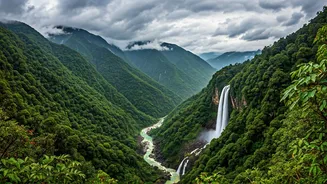
Perched on the edge of the East Khasi Hills, Cherrapunji—now officially known by its traditional name, Sohra—is a name synonymous with rain. For decades, it held the title of the wettest place on Earth, a distinction now held by its nearby neighbour,
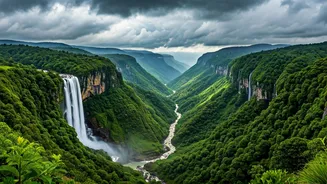
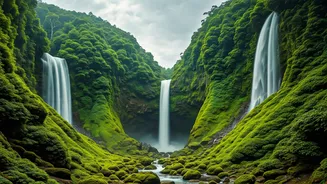
Mawsynram. But titles are secondary to experience. The relentless monsoon rain that lashes this plateau has carved a landscape of dramatic gorges and lush, emerald valleys. More importantly, it has given birth to a legion of waterfalls that plummet from staggering heights, each with a story to tell. To visit Cherrapunji is to step into a world sculpted by water, where every turn in the road might reveal another cascade, another testament to nature's raw power and artistry.
Nohkalikai: A Plunge of Tragic Beauty
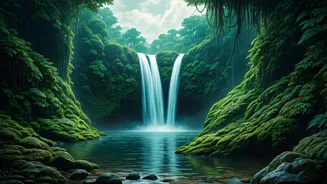
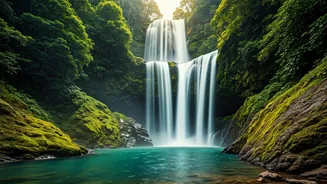
The most famous of Cherrapunji's waterfalls is Nohkalikai. It is India's tallest plunge waterfall, a single, unbroken column of water that drops an astonishing 1,115 feet into a deep, turquoise-green pool. The sheer scale is humbling. From the viewing platform, the water looks like a silver ribbon unfurling against a dark cliff face. But its spectacular beauty is shadowed by a somber local legend. The name 'Nohkalikai' translates to 'Jump of Ka Likai', referencing a Khasi tale of a mother who, driven mad by grief, leapt from the cliff's edge. The story lends a poignant, haunting quality to the falls, reminding visitors that this untamed beauty is intertwined with deep human emotion and folklore. The mist that often shrouds its base feels like the earth’s own sigh.
Seven Sisters: A Monsoon Symphony
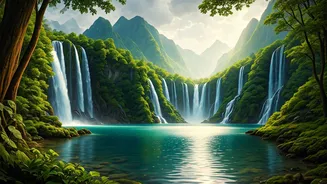
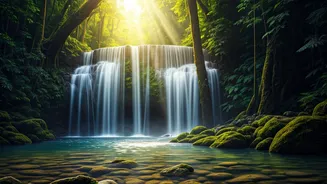
If Nohkalikai is a powerful solo, the Nohsngithiang Falls, popularly known as the Seven Sisters Falls, is a grand symphony. This segmented waterfall is comprised of seven distinct streams that cascade side-by-side down a wide limestone cliff. The spectacle is entirely dependent on the rain. During the dry season, some streams may vanish, but during the peak monsoon, it’s a magnificent, roaring curtain of water, a full 70 metres wide. The best views are often during sunset, when the sun's fading rays illuminate the cascading water, creating a mesmerising display of light and colour. It represents the collective, overwhelming force of the monsoon, a broad, beautiful expression of the region's defining characteristic.
Dainthlen: Where a Legend was Slain
Unlike the other falls that you admire from a distance, Dainthlen Falls offers a different, more intimate perspective. Here, the river rushes across a flat, rocky riverbed before suddenly dropping into a gorge. You can walk right up to the edge, feeling the spray and hearing the thunderous roar from above. The riverbed itself is fascinating, marked by peculiar, pot-hole-like formations. These marks, according to Khasi legend, were left by the tools used to slay a 'Thlen,' a gigantic serpent that once terrorised the local villages. Standing there, you are literally on top of a myth, a landscape where folklore is etched into the very stone, capturing the 'untamed' essence of a primal battle between man and beast.
Beyond the Falls: The Living Bridges
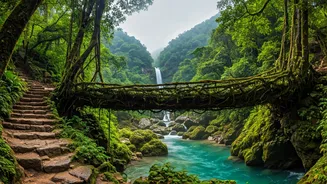
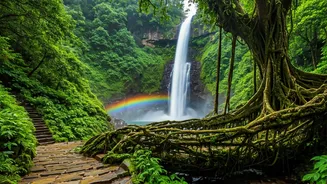
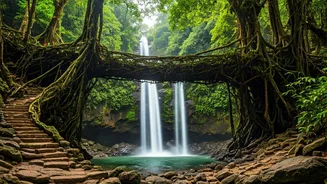
The magic of Cherrapunji’s wilderness is not limited to its waterfalls. The same water that carves gorges also nourishes the incredible Living Root Bridges. These are not built, but grown. For generations, the Khasi people have guided the aerial roots of the Ficus elastica tree across rivers and streams, weaving them into sturdy, living structures that become stronger with time. To walk across one of these bridges, a perfect synthesis of human ingenuity and natural process, is to understand the deep connection between the people and this unique environment. They are as much a part of Cherrapunji’s soul as the waterfalls themselves, a quiet, patient counterpoint to the thundering cascades.