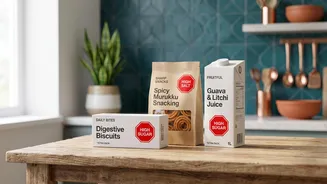









Introducing the Red Hexagon
The Food Safety and Standards Authority of India (FSSAI) has proposed a major change to how packaged foods are labelled. The plan is to introduce a clear, unmissable warning label on the front of packs for products that are high in salt, sugar, or fat.
The proposed design is a red hexagon with a white background, prominently placed on the top left of the package. Inside the hexagon, text will explicitly state if the product is “HIGH IN SUGAR,” “HIGH IN SALT,” or “HIGH IN FAT.” If a product exceeds the threshold for multiple nutrients, they will all be listed within a single hexagon. This Front-of-Pack Labelling (FoPL) system is meant to give consumers a quick, at-a-glance understanding of the product's nutritional profile, a significant shift from the current system where detailed information is often tucked away in small print on the back.
Why the Sudden Change?
This move is driven by a growing public health crisis. Unhealthy diets are linked to a significant portion of India's total disease burden, with rising rates of obesity and non-communicable diseases (NCDs) like diabetes and heart conditions causing alarm. Health experts argue that many consumers are often unaware of the high levels of unhealthy nutrients in processed foods, sometimes misled by attractive packaging that uses terms like 'healthy' or 'multigrain'. The goal of the new warning labels is to cut through this marketing clutter. By providing a simple, visual cue, the FSSAI aims to empower consumers to make more informed choices for themselves and their families, a move supported by the Supreme Court, which has been pushing for faster implementation.
The Debate Around the Labels
While the proposal is backed by public health advocates, it has faced resistance from the food industry. One major concern raised by food companies is the use of the colour red. They argue that Indian consumers associate red dots with non-vegetarian products, and a red warning label could cause confusion. There is also debate over the thresholds that determine if a food is 'high' in a certain nutrient. The industry has called for these limits to be based on typical serving sizes rather than a standard 100g/100ml measure, which they claim is more scientific. Initially, FSSAI considered a 'Health Star Rating' system, which would rate foods from half a star to five stars. However, health experts criticised this, arguing it could be misleading; a product high in sugar could still get a better star rating by adding minimal 'positive' ingredients like fibre, effectively masking its unhealthy nature. FSSAI has since moved towards the more direct warning label system.
How This Affects Your Shopping Cart
Once implemented, these labels could fundamentally change how you shop. Imagine standing in the biscuit aisle, faced with two similar-looking packets. If one has a glaring “HIGH IN SUGAR” warning and the other doesn't, it makes your decision much clearer. This transparency is intended to nudge consumers towards healthier options and, in turn, pressure manufacturers to reformulate their products to avoid the red hexagon. Companies may be forced to reduce sugar, salt, and fat content to make their products more appealing to health-conscious shoppers. However, it's important to remember that these labels are a tool, not a final judgment. A food with a warning isn't automatically 'bad' in moderation, and a food without one isn't necessarily a superfood. The labels provide one crucial piece of information to consider alongside the full ingredient list and your overall diet.