






The Obvious Answer: The Chase Master
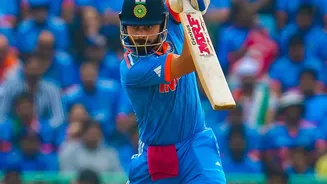
Any discussion about patterns in Virat Kohli's batting inevitably starts with his legendary prowess in a run chase. The title 'chase master' isn't just a fan-given moniker; it's a statistically proven phenomenon. Across formats, Kohli's numbers when batting second
are staggering. He holds the record for the most centuries in ODI run chases, with a remarkable 19 of his 32 tons in the format coming while pursuing a target. More importantly, a vast majority of these have resulted in Indian victories, cementing his reputation as the ultimate finisher. His average in successful ODI run chases is an astonishing 89.59, with 24 centuries. This pattern holds true in the high-pressure environment of the IPL, where he is the only batsman to cross the 4,000-run mark in chases. In games his team won while chasing, his IPL average soars past 61. The famous 133 off 86 balls against Sri Lanka in Hobart in 2012, where India chased 321 in under 40 overs, is a classic example of this pattern in action. Clearly, having a target to hunt brings out a special, calculated aggression in him.
Beyond the Scoreboard: The Pressure Catalyst
While chasing is a significant factor, it doesn't tell the whole story. A deeper look reveals that the 'strange pattern' is less about when he bats and more about the circumstances. Kohli's biggest knocks are often born from immense pressure. This pressure can be situational within a match—like a top-order collapse—or contextual, such as a do-or-die tournament game or a response to personal criticism. Think of his twin centuries (115 and 141) against Australia in Adelaide in 2014. In his very first Test as captain, on a difficult fifth-day pitch, he decided to chase an improbable 364, falling just short but making a defining statement. Similarly, his 153 against South Africa in Centurion in 2018 came when no other Indian batsman passed 50, a lone warrior fighting a fearsome pace attack on a spicy pitch. This trend is amplified in white-ball cricket. His iconic 82 against Australia in the 2016 T20 World Cup came when India were 94-4, needing 67 from the last six overs. He thrives when the odds are stacked against him and the team's back is against the wall. He seems to view pressure not as a threat, but as an invitation to take control.
The Statement Innings: A Pattern of Defiance
Perhaps the most compelling pattern is psychological. Many of Kohli's greatest innings are 'statement knocks'—performances that serve as a direct answer to a challenge, a slump in form, or external criticism. His 149 against England at Edgbaston in 2018 is a prime example. After a disastrous 2014 tour of England where he struggled immensely, he returned four years later and single-handedly carried the team with a masterful century, silencing all questions about his ability in English conditions. After going through a well-documented century drought, his 186 against Australia in Ahmedabad was an epic of patience and endurance that broke the spell. More recently, after a period where his place in the T20 side was questioned, he produced one of the greatest T20 innings of all time—the unbeaten 82 against Pakistan in the 2022 T20 World Cup at a packed MCG. These are not just runs; they are declarations of his resilience. The pattern suggests that a challenged Kohli is the most dangerous Kohli. This was evident even in his early days; he scored a match-saving 90 in a domestic game hours after his father's death, a formative experience that showed he was made of different steel.
The Big Picture: When Context Creates a King
So, what is the strange pattern? It's not just chasing. It's not just a specific opponent or venue, though he has favoured teams like Australia, against whom he has 17 international centuries. The true pattern is a confluence of high stakes, immense pressure, and a personal point to prove. His biggest knocks are reactive masterpieces. They are a response to a scoreboard, a match situation, or a narrative surrounding his own form and legacy. He transforms pressure into fuel, using it to narrow his focus and enter a state of supreme concentration. While many players shrink in clutch moments, Kohli's stats consistently show that his impact and strike rate actually increase in high-pressure situations. The pattern isn't found in the scorebook alone but in the context surrounding the innings. His greatest performances are almost always delivered when the team, and he himself, needs them most.