




Why Explosive and Functional?
Traditional bodybuilding often focuses on isolating muscles to increase their size (hypertrophy). While effective for aesthetics, it doesn’t always translate to real-world strength. Functional strength, on the other hand, is about training movements,
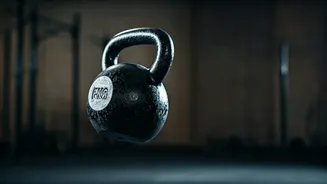
not just muscles. It’s the ability to lift a heavy suitcase into an overhead bin, play a game of cricket without pulling a muscle, or lift your child with ease. Explosive, or ballistic, training is the key to this. By moving a weight with maximum velocity, you train your nervous system to recruit muscle fibres quickly and powerfully. This builds Type II muscle fibres, the kind responsible for strength and speed. The kettlebell, with its unique centre of gravity, is the perfect tool for this.
The Foundation: Kettlebell Swing
The two-handed kettlebell swing is the cornerstone of any explosive routine. It’s not a squat or a front raise; it’s a powerful hip hinge. This movement teaches you to generate force from your glutes and hamstrings—the engine of your body.
How to do it: Stand with feet shoulder-width apart, with the kettlebell about a foot in front of you. Hinge at your hips, keeping your back flat, and grip the handle with both hands. Hike the bell back between your legs. Then, in one explosive movement, drive your hips forward and squeeze your glutes, allowing the bell to float up to chest height. Let gravity bring it back down and guide it between your legs for the next rep. The power comes entirely from your hips, not your arms.
Building Up: The Kettlebell Clean
The clean is your gateway to all overhead kettlebell movements. It teaches you to move the bell from the floor to the 'rack' position (resting on your forearm, tucked into your chest) efficiently and safely. It's a full-body power generator.
How to do it: Start like the swing, but with one hand. As you explosively drive your hips forward, keep your elbow tucked in and pull the kettlebell upwards. Instead of letting it float out, you 'tame the arc'. As it reaches chest height, rotate your hand around the bell and guide it softly into the rack position. Your wrist should be straight and your knuckles facing the ceiling. The landing should be gentle, not a crash onto your forearm. Lower it back down with control and repeat.
Total Body Power: The Push Press
Once you've mastered the clean, you can add the push press. This links lower-body power with upper-body strength, creating a wave of force that travels through your entire body.
How to do it: Start with the kettlebell in the rack position. Dip slightly at the knees, then explosively extend your legs and hips to drive the bell overhead. Your arm is just guiding the final part of the movement; the primary force comes from your legs. Lock out your elbow at the top, with your bicep next to your ear. Lower it back to the rack position with control. This is far more athletic than a simple strict press.
Putting It All Together: The Routine
The key to a 'quick' routine is intensity. Instead of long rest periods, we’ll use a structure that keeps you moving. Pick a moderately heavy kettlebell—one you can swing for 10-15 reps with perfect form.
Workout A (Full Body Power):
Set a timer for 15 minutes.
- Minute 1: 10 Kettlebell Swings (Right Arm)
- Minute 2: 10 Kettlebell Swings (Left Arm)
- Minute 3: 5 Kettlebell Clean & Push Press (Right Arm)
- Minute 4: 5 Kettlebell Clean & Push Press (Left Arm)
- Minute 5: Rest
Repeat this 3 times.
Workout B (Swing Focus):
Set a timer for 10 minutes.
Every minute on the minute (EMOM), perform 10 two-handed kettlebell swings. Use the remainder of each minute to rest. The goal is consistent, explosive reps. As you get stronger, you can increase the reps to 12 or 15 per minute.