







The Sun’s Hidden Engine Room
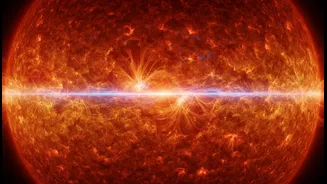
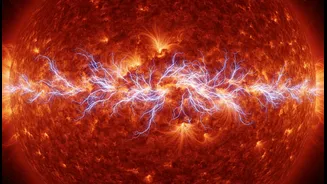
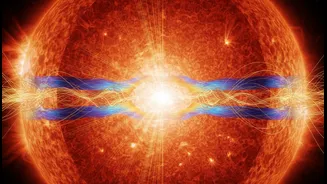
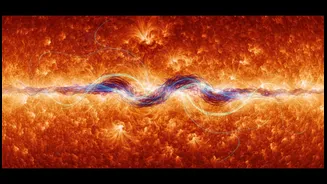
Deep beneath the Sun’s turbulent surface lies a region of immense scientific interest: the tachocline. It’s not a solid place, but a vast transition layer, estimated to be about 28,000 to 35,000 kilometres thick. Think of it as a boundary separating two
distinct zones of the solar interior. Below it, the Sun’s radiative zone rotates like a solid, unified ball. Above it, the convection zone churns like boiling water, with different parts rotating at different speeds—faster at the equator and slower at the poles. The tachocline is the shear layer where these two dramatically different rotational speeds meet. First theorised in 1992, its existence was later inferred through helioseismology, the study of the Sun's interior by observing waves on its surface. This layer is believed to play a critical role in generating the Sun's powerful magnetic field, a process known as the solar dynamo.
The Cradle of Solar Magnetism
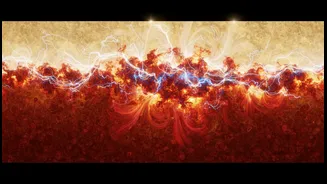
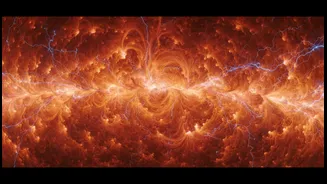
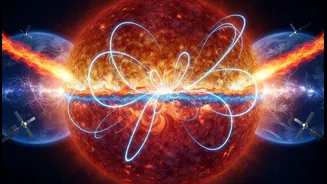
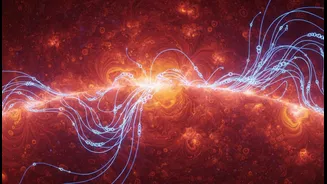
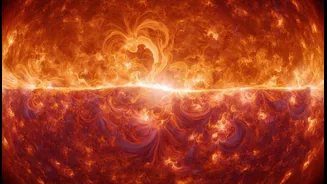
The immense shear forces within the tachocline are believed to be the primary engine for the Sun's magnetic activity. According to dynamo theory, the intense stretching and twisting of plasma in this layer amplifies weak magnetic fields into the powerful, complex structures that dominate solar behaviour. These strong magnetic fields, generated deep within the Sun, don't stay there. They become buoyant and can rise through the convection zone to emerge on the surface as sunspots and active regions. These are the very areas where explosive events like solar flares and coronal mass ejections (CMEs) originate. Therefore, understanding the dynamics of the tachocline is not just an academic exercise in stellar physics; it is directly linked to the root causes of the space weather that can impact Earth. By studying this deep, unseen layer, scientists hope to understand the fundamental lifecycle of the solar magnetic field, from its birth to its dramatic eruption into space.
From Deep Physics to Better Forecasts
Current space weather forecasting relies heavily on observing the Sun's surface and corona. We see a sunspot forming or a magnetic filament becoming unstable, and we predict an eruption might occur. This is akin to forecasting a storm by looking at the clouds already forming. Studying the tachocline offers the potential for much earlier warnings. By understanding the conditions within this dynamo layer, scientists could potentially model how large magnetic structures are built and when they might become unstable enough to rise to the surface. Researchers are working on complex simulations that connect the shear flows in the tachocline to the strength and shape of the magnetic fields produced. While this doesn't mean we can predict a specific solar flare days in advance, it could lead to better long-term forecasts about the overall activity level of a solar cycle and identify periods of heightened risk with more confidence. It's a shift from reactive observation to proactive, physics-based prediction.
Protecting Our Technological Backbone
The stakes for improving these forecasts are incredibly high. A major solar eruption aimed at Earth can have devastating consequences for our technology-dependent civilisation. The intense radiation from a solar flare can disrupt high-frequency radio communications and interfere with GPS signals, affecting aviation, shipping, and logistics. Energetic particles can damage or destroy the sensitive electronics of the thousands of satellites we rely on for everything from financial transactions to telecommunications. Perhaps most critically, a powerful CME can induce massive electrical currents in power grids on the ground, potentially overloading transformers and causing widespread, long-lasting blackouts, as happened in Quebec in 1989. Having more reliable and longer-lead-time forecasts would give grid operators, satellite controllers, and airlines crucial time to take protective measures, such as re-routing flights, putting satellites into a safe mode, or isolating parts of the power grid to prevent a cascading failure.