



A New Level of Ambition
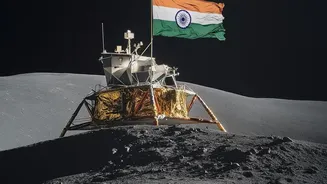
Chandrayaan-4 represents a monumental leap in India's space exploration journey. While Chandrayaan-3 proved ISRO's mastery of soft-landing on the challenging lunar south pole, this new mission aims to complete the round trip. The primary goal is to collect
up to 3 kg of lunar regolith (soil and rock) and potential water ice from the polar region and return it to Earth for scientific analysis. If successful, India will join an exclusive club of nations — currently comprising only the United States, Russia, and China — that have accomplished this feat. The scientific value of these samples is immense. Studying them in advanced labs on Earth will provide unparalleled insights into the Moon's origin, its geological history, and the potential for in-situ resource utilization, like using water ice for future astronaut missions.
A Mission in Five Modules
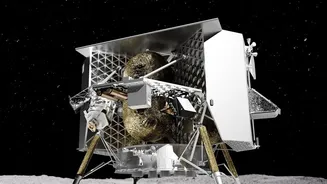
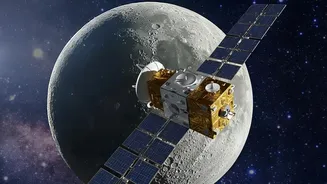
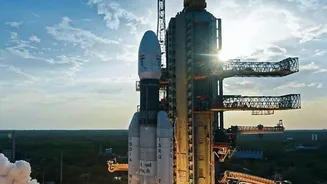
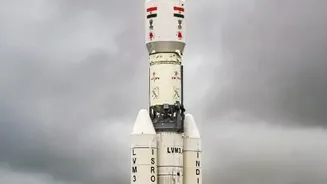
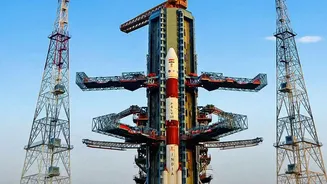
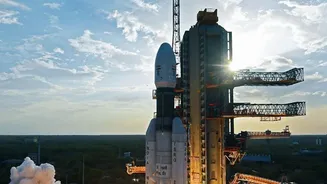
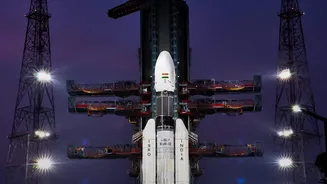
The complexity of Chandrayaan-4 is reflected in its architecture, which is planned to involve five separate modules launched on two powerful rockets. This dual-launch strategy is necessary due to the sheer mass of the combined spacecraft, which is too heavy for a single LVM3 rocket. The five components are the Propulsion Module, Descender Module, Ascender Module, Transfer Module, and Re-entry Module. First, the two stacks will launch separately and perform a crucial docking manoeuvre in Earth's orbit to form a single integrated spacecraft. This in-space assembly is a critical new capability for ISRO, one it has been testing with precursor missions like the Space Docking Experiment (SPADEX).
The Journey to the Moon and Back
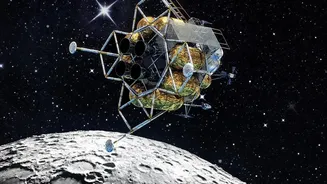
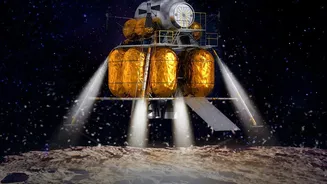
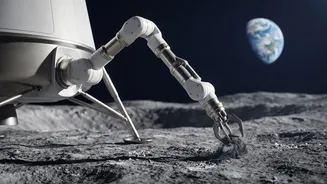
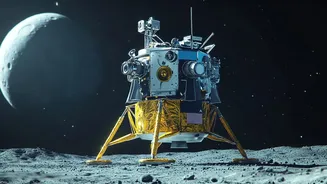
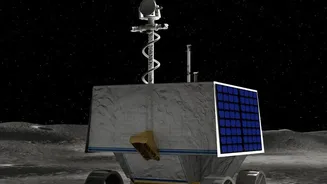
Once assembled, the integrated spacecraft will journey to the Moon. In lunar orbit, the lander (Descender Module) and the Ascender Module will separate and begin their descent to a pre-determined site near the south pole. After a successful soft landing, the next phase begins. A robotic arm on the lander will collect surface samples, while a drill will gather material from beneath the surface. These samples will be carefully sealed in a container aboard the Ascender Module. The real challenge then begins: for the first time, an Indian-made craft will have to launch from the surface of another celestial body. The Ascender will lift off, leaving the lander behind, and rendezvous with the Transfer and Re-entry modules waiting in lunar orbit.
Docking, Transfer, and a Fiery Return
In lunar orbit, another delicate docking procedure will take place. The Ascender will connect with the waiting modules, and the precious sample container will be robotically transferred to the Re-entry Module. Once the transfer is complete, the Ascender is discarded. The Transfer Module then fires its engines to begin the journey back to Earth, carrying the Re-entry Module with its cargo. As it nears our planet, the Re-entry Module will separate and perform a high-speed, ballistic re-entry through the atmosphere, designed to protect the samples from heat and contamination. It will then land safely, delivering a piece of the Moon into the hands of Indian scientists. This entire sequence, from launch to return, is a complex dance of orbital mechanics and robotic precision.
Paving the Way for the Future
Scheduled for launch around 2028, the Chandrayaan-4 mission is more than just a scientific endeavour; it is a critical stepping stone for India's future in space. The technologies being developed and validated — from orbital docking and robotic sample transfer to a lunar launch and high-speed re-entry — are foundational for even more ambitious goals. ISRO has stated that this mission is essential for developing the capabilities needed for a future crewed lunar landing, which India aims to achieve by 2040. Each step of the Chandrayaan-4 mission will build India’s expertise, pushing the boundaries of what is possible and cementing its status as a leading spacefaring nation.