






A Two-Part Spacewalking Saga
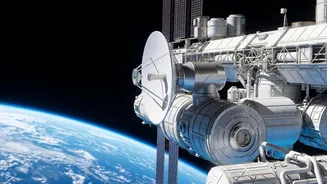
On August 25, European Space Agency (ESA) astronaut Sophie Adenot and NASA's Anil Menon ventured outside the International Space Station (ISS) for a gruelling six-and-a-half-hour spacewalk. Their mission, US EVA-98, was to install a spare Space-to-Ground
Antenna (SGANT), a vital piece of hardware that enables high-speed data and voice communication with Mission Control on Earth. This was not their first attempt. An initial spacewalk on August 18 saw the duo successfully remove the faulty antenna, but stubborn bolts and connectors ate into their schedule, forcing a postponement of the installation. This second outing was crucial to finishing the job and restoring the station's full communication redundancy. The original antenna had been failing to properly track communication satellites for months, making its replacement a high priority for station maintenance.
Who is Sophie Adenot?
This successful repair marked the second career spacewalk for Sophie Adenot, a colonel in the French Air and Space Force and a former helicopter test pilot. Selected as part of the 2022 ESA astronaut class, she is the second French woman to become a career astronaut. Her first spacewalk on August 18 already made history, establishing her as the first French woman to perform an extravehicular activity (EVA). With the completion of this second EVA, Adenot has now logged a total of 12 hours and 53 minutes working in the vacuum of space. Her path to the stars is built on a distinguished career, including experience as France's first female helicopter test pilot and flying search and rescue missions in hostile environments. She launched to the ISS in February 2026 as part of the SpaceX Crew-12 mission.
An Orbital Ballet of Tools and Teamwork
Spacewalks are meticulously choreographed and physically demanding. While tethered to the station by safety cables, Adenot and Menon worked in bulky, pressurized suits that make every movement a challenge. From inside the station, NASA astronauts Jack Hathaway and Jessica Meir operated the Canadarm2 robotic arm to assist them. For this mission, Menon rode the robotic arm to the external platform where the spare antenna was stored, a piece of equipment that had been waiting for its moment since 2009. Adenot translated—or moved hand-over-hand—along the station's exterior to meet him. Together, they retrieved the new antenna, installed it, and then secured the old, failed unit in a permanent stowage location. The success of the mission prompted a celebratory message from Mission Control: "You just saved the video dish!"
Why This Repair Matters
The ISS has multiple communication systems, so the crew was never in immediate danger. However, the failed SGANT antenna compromised the station's redundancy. Restoring it was about ensuring the robustness and reliability of the connection between the orbiting laboratory and Earth. These high-speed links are not just for sending emails or making video calls; they are essential for transmitting vast amounts of scientific data, telemetry from the station's systems, and providing a constant, stable link for mission operations and crew support. This repair, the 283rd spacewalk in support of the ISS, guarantees that the station's critical data lifeline remains strong, underscoring the importance of hands-on maintenance to keep the multi-billion-dollar outpost running smoothly.