





The Cosmic Data Bottleneck
Since the dawn of the space age, NASA and other agencies have relied on radio frequency (RF) communications to talk to spacecraft. While incredibly reliable, RF technology has a fundamental limitation: bandwidth. As scientific instruments become more
powerful, capturing high-definition video and vast amounts of data, the RF pipeline has become a bottleneck. Transmitting a complete, high-resolution map of Mars using current RF systems could take as long as nine weeks. This delay limits the pace of discovery and the ability to conduct more complex, data-heavy science in real-time. The demand for more data from missions to the Moon, Mars, and beyond has pushed engineers to find a revolutionary new solution.
A Solution Written in Light
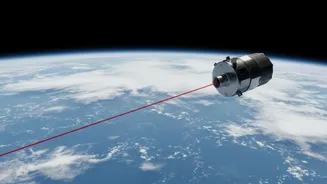
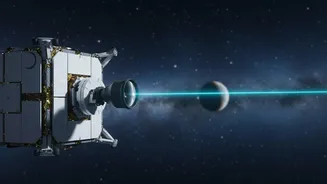
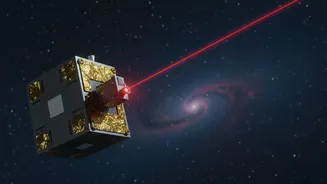
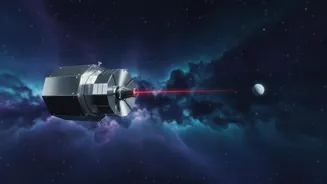
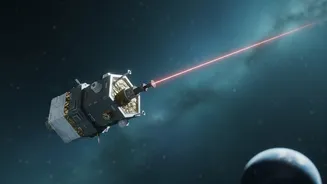
The answer lies in a different part of the electromagnetic spectrum: infrared light. Laser or 'optical' communications use invisible beams of near-infrared light to carry information. While both radio waves and light travel at the same speed, the physics of infrared light allows it to carry vastly more data. Because its wavelength is much shorter, data can be packed into significantly tighter waves. This means a single transmission can contain 10 to 100 times more information than a comparable RF signal. It's the difference between sending a text message and streaming an ultra-high-definition movie. This technology also comes with the added benefits of being smaller, lighter, and requiring less power, which are crucial advantages for any spacecraft.
NASA's Landmark Test
NASA has been putting this theory into practice with its Deep Space Optical Communications (DSOC) experiment. Launched in October 2023 aboard the Psyche spacecraft, the DSOC system was designed to test laser communications far beyond the Earth-Moon system. The demonstration has been a resounding success. In December 2023, the system streamed a high-definition video of a cat named Taters from 19 million miles away, achieving a maximum data rate of 267 megabits per second (Mbps)—faster than many home broadband connections. The experiment concluded in September 2025 after exceeding all its goals, successfully exchanging data from as far as 218 million miles away. These tests have proven that optical communication is a viable and robust technology for future deep space missions.
Unlocking a New Era of Discovery
The implications of this technological leap are enormous. With data rates far exceeding the few megabits per second offered by RF systems at Mars-like distances, scientists can design entirely new kinds of instruments and experiments. Future crewed missions to Mars could feature live, high-definition video feeds, allowing for unprecedented connection and collaboration with Earth-bound teams. The nine weeks it would take to send a Mars map via radio could be cut down to just nine days. This ability to quickly downlink massive datasets will accelerate the pace of scientific discovery, letting us learn more about our solar system faster than ever before.
Challenges on the Horizon
Despite its success, the path to making optical communication a standard feature is not without its hurdles. The narrowness of the laser beam, while providing security against interception, demands incredibly precise pointing accuracy. A spacecraft millions of miles away must aim its laser with pinpoint precision to hit a receiver on Earth. Another significant challenge is Earth's atmosphere, as clouds can disrupt the laser signal. Overcoming this may require a global network of ground stations in diverse climates to ensure there is always a clear line of sight. The extreme environment of space, with its radiation and temperature swings, also demands highly durable optical components.