


Our Invisible Weather System
When we think of weather, we picture rain, wind, and sunshine. But there's another kind of weather that originates 93 million miles away, on the surface of the sun. Known as space weather, it refers to the changing conditions in space driven by solar
activity. The main events are solar flares—immense explosions of radiation—and coronal mass ejections (CMEs), which are massive clouds of charged particles and magnetic fields hurled into space. While Earth's magnetic field protects us from the worst of this constant solar wind, powerful bursts aimed our way can have significant consequences for our technology-dependent society.
A Sky Crowded with Technology
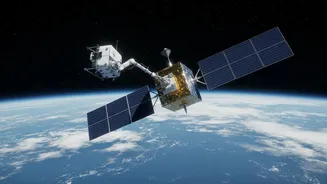
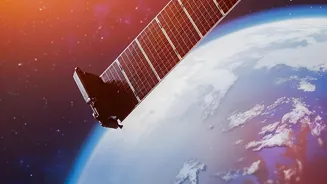
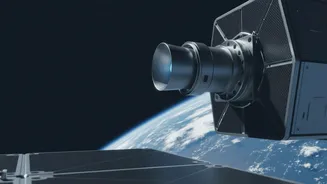
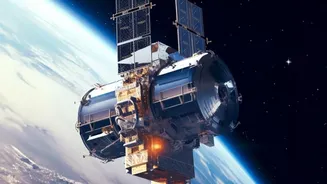
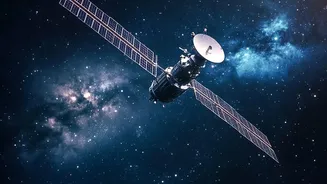
The region just beyond our atmosphere, particularly Low Earth Orbit (LEO), is becoming increasingly crowded. The world is in the midst of a satellite boom, driven by companies like SpaceX's Starlink, OneWeb, and Amazon's Project Kuiper. These 'mega-constellations' aim to blanket the globe in high-speed, low-latency internet. At the start of 2026, the market for these constellations was already valued at over USD 7 billion and is projected to skyrocket to over USD 40 billion by 2034. This explosion in satellite deployment, while revolutionary for global connectivity, dramatically increases the number of high-value assets exposed to the hazards of space weather.
The Danger in Orbit
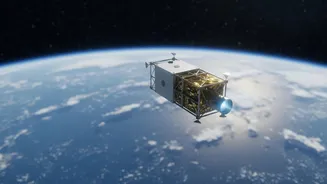
Satellites are uniquely vulnerable because they operate outside the full protection of Earth's atmosphere. There are two primary threats: radiation and atmospheric drag. High-energy particles from solar storms can damage sensitive electronics, degrade solar panels, and cause 'phantom commands' that could make a satellite tumble or change its orientation. Severe events can shorten a satellite's operational lifespan or cause outright failure. Secondly, a major solar storm heats and expands Earth's upper atmosphere. This increases the density, creating more drag on LEO satellites. This extra drag can slow a satellite down, causing its orbit to decay and potentially leading to collisions with other satellites or space debris. In a widely cited 2022 incident, a geomagnetic storm was blamed for the loss of up to 40 newly launched Starlink satellites, which failed to reach their intended orbit due to increased atmospheric drag.
Real-World Consequences on the Ground
When space weather affects satellites, the disruption is felt on Earth. An interruption to navigation satellites could lead to widespread degradation of GPS services for days. This impacts more than just your car's map; aviation, shipping, precision agriculture, and even high-frequency financial trading rely on the precise timing signals from these systems. Communications can also be severely disrupted. Solar flares can produce radio waves that drown out signals, while geomagnetic storms can disturb the ionosphere, the layer of the atmosphere that many radio signals bounce off. For a world increasingly reliant on satellite internet, the economic impact of a major, widespread outage could be enormous, with some estimates suggesting a worst-case scenario could cost trillions of dollars.
The High-Stakes Race to Predict
Like terrestrial weather, space weather cannot be stopped, but it can be forecast. Agencies like the USA's Space Weather Prediction Center (SWPC) act as official sources, using a network of ground-based and satellite observatories to monitor the sun. By watching for solar flares and tracking CMEs as they travel through space, forecasters can issue watches and warnings. These predictions are crucial. A forecast gives satellite operators precious hours of lead time to take protective measures, such as temporarily powering down sensitive electronics or adjusting a satellite's orientation to minimize exposure. It’s a vital tool for mitigating risk for assets worth billions of dollars.