




The Search for Alien Skies
For decades, the study of exoplanets—planets orbiting other stars—was a game of shadows and whispers. We could detect their presence, measure their size and mass, but understanding what they were truly like remained out of reach. This was especially true
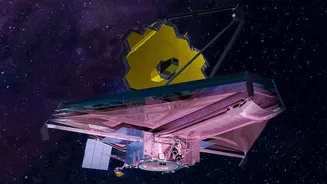
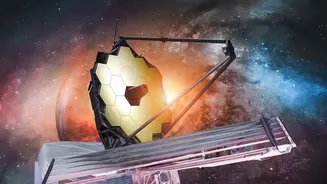
for rocky, Earth-sized worlds. Their thin, wispy atmospheres, if they existed at all, were nearly impossible to detect. That has all changed with the James Webb Space Telescope (JWST). Its powerful infrared instruments are finally pulling back the curtain, allowing us to a perform a kind of long-distance, cosmic weather report on planets light-years away.
Webb's Infrared Advantage
How does Webb see an atmosphere from trillions of kilometres away? It uses a technique called spectroscopy. When a planet passes in front of its star, some of the starlight filters through the planet's atmosphere. Different gases in that atmosphere absorb specific wavelengths, or colours, of light. By looking at the starlight that reaches its mirrors, Webb can identify which wavelengths are missing and deduce the chemical composition of the alien sky. It can also measure the heat radiating directly from the planet's surface and atmosphere. This provides clues about temperature and whether an atmosphere is present to distribute that heat around the planet.
A Glimpse of a Hellish Lava World
One of the most significant recent findings comes from a super-Earth named 55 Cancri e, located about 41 light-years away. This planet orbits its star so closely that its surface is a molten ocean of magma. Logic suggested such a hot world, blasted by stellar radiation, couldn't possibly hold onto an atmosphere. But Webb's data told a different story. The planet’s dayside was significantly cooler than models predicted for bare rock, suggesting something was moving the heat around. Furthermore, Webb detected a chemical fingerprint indicating the presence of an atmosphere rich in carbon monoxide and carbon dioxide. This is the best evidence to date for a substantial atmosphere on a rocky exoplanet.
An Atmosphere Forged in Fire
So where did this atmosphere come from? Scientists believe it's a 'secondary' atmosphere. Any primordial gases from the planet's formation would have been burned away long ago. Instead, the current atmosphere is thought to be continuously replenished by gases bubbling out of the massive magma ocean itself. In this hellish environment, the planet is essentially creating and sustaining its own air through constant volcanic activity on a global scale. More recent studies have even pointed to a surprising amount of hydrogen in the mix, challenging existing models of rocky planet evolution. While 55 Cancri e is far too hot to be habitable, it provides a perfect natural laboratory for studying the complex interactions between a planet's surface, interior, and atmosphere.
Sometimes, No News Is Big News
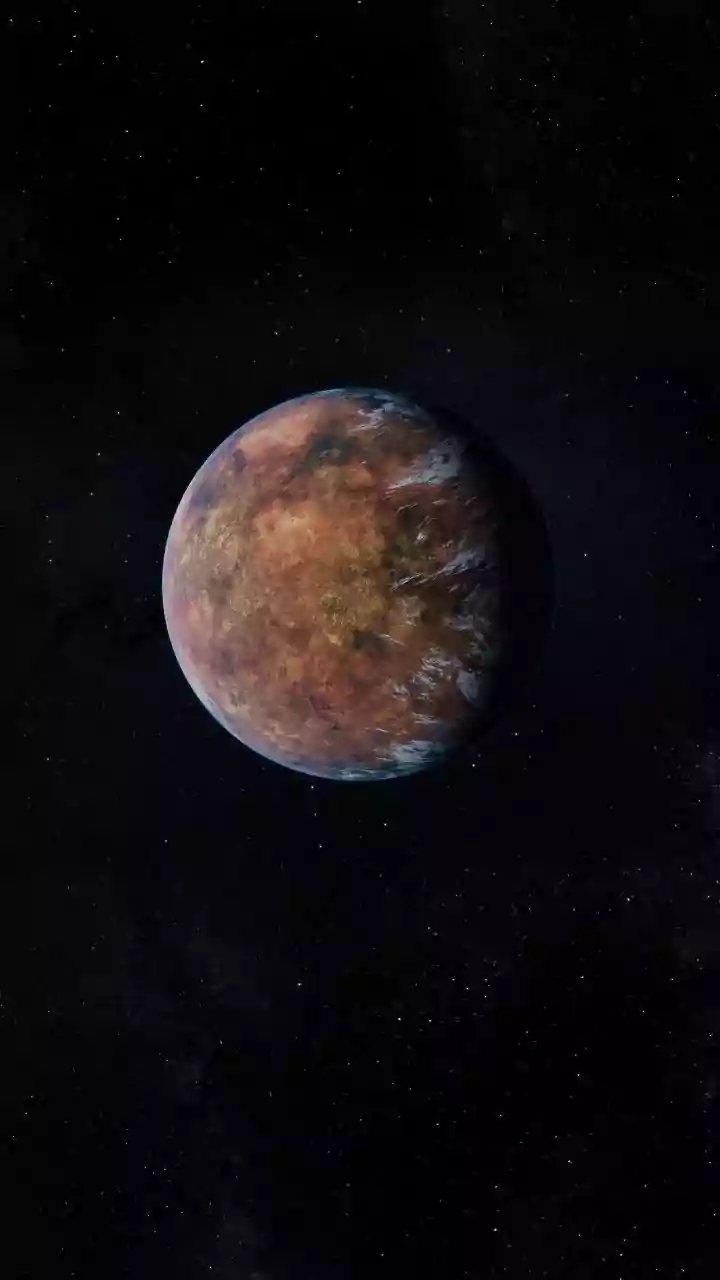
Just as important as finding atmospheres is learning where they don't exist. The TRAPPIST-1 system, a famous collection of seven Earth-sized rocky planets, has been a prime target for Webb. Hopes were high for TRAPPIST-1 d, a planet residing in the star's habitable zone where liquid water could theoretically exist. However, Webb's observations found no evidence of a thick, Earth-like atmosphere. While disappointing for those hoping for a twin Earth, this is a crucial scientific result. It helps astronomers refine their theories about which planets can retain atmospheres, especially those orbiting volatile red dwarf stars like TRAPPIST-1, which are known to unleash powerful flares that can strip atmospheres away.
The First Step on a Long Journey
The findings from worlds like 55 Cancri e and TRAPPIST-1 represent the dawn of a new era in astronomy. For the first time, we are moving beyond simply discovering rocky planets to truly characterising them. Each observation, whether it reveals a strange new atmosphere or the starkness of bare rock, provides a vital piece of the puzzle. These early studies of extreme, uninhabitable worlds are teaching scientists how to interpret the faint signals from distant skies, honing the techniques that will one day be used to analyse the atmospheres of cooler, more temperate planets—planets that might just have the right conditions for life.