









A Blueprint Held in Memory
The construction of a Chundan Vallam, a boat that can stretch over 100 feet and carry more than 100 rowers, begins not on paper, but in the mind of the master craftsman, or Mootashari. For generations, the intricate specifications for these vessels have
been passed down orally, guided by principles laid out in the ancient treatise, the Sthapathya Veda. Unlike modern shipbuilding that relies on detailed digital models, the snake boat's design is a living blueprint of experience and tradition. This makes the process of ensuring perfect bilateral symmetry—a crucial factor for speed and stability—a task of immense skill and intuition. The entire village often participates, but it is the Mootashari's vision that guides every plank and every nail.
The Master's Eye: Judging by Sight and Shadow
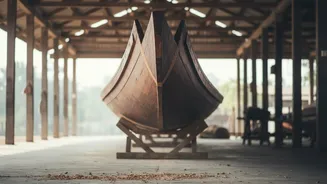
One of the most fundamental techniques for checking symmetry is a method known as 'Kan Nottam,' or eye-measurement. The master craftsman relies on their highly trained eye, developed over decades of apprenticeship and practice. They will stand at a distance from the hull, often during the low light of dawn or dusk, to assess its form. The long shadows cast by the sun highlight the subtle curves and lines of the wood. Any slight imperfection, bulge, or asymmetry is immediately revealed by a distortion in the shadow. This visual inspection is repeated countless times from various angles, allowing the craftsman to perceive the fairness and balance of the hull in a way that mechanical tools cannot replicate. It is a holistic assessment of the boat's form, seeking a perfect, flowing curve from bow to stern.
The Trial by Water: An Ancient Litmus Test
Before the hull is fully assembled and waterproofed, the craftsmen employ another ingenious, low-tech method to test for balance: the trial by water. The partially constructed hull is carefully filled with water. The craftsmen then meticulously observe the water level along the entire length of the interior. If the hull is perfectly symmetrical and balanced, the water line will be perfectly even from one end to the other. If the water is higher on one side, it indicates that section is heavier or shaped differently, requiring careful adjustments. This simple yet effective process acts as a natural spirit level, using the laws of physics to reveal imbalances that would be imperceptible to the naked eye alone. This step ensures that the boat will sit true in the water, a critical factor for achieving maximum speed during a race.
Symmetry by Feel and by Thread
Beyond sight, touch plays a crucial role. Craftsmen will run their bare hands over the surface of the wooden planks, feeling for any unevenness or inconsistencies in the finish. Their palms and fingers can detect minute variations that would otherwise go unnoticed. To verify the larger geometry, they use a simple but effective tool: a tightly stretched thread or string. By running a line from the tip of the bow to the stern along the boat's central axis, they establish a perfect centerline. From this line, they can take measurements to either side at various points along the hull. This allows them to check if corresponding points on the port and starboard sides are equidistant from the center, ensuring the boat's width and curves are mirror images of each other. This combination of tactile feedback and simple geometry ensures a level of precision that is astonishing for a handcrafted object of this scale.