



A New View of a Familiar Galaxy
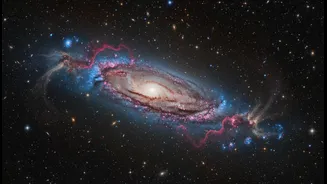
To mark the fourth anniversary of science operations for the James Webb Space Telescope (JWST), NASA and ESA have released an unprecedented image of Centaurus A. Located about 11 million light-years away, this galaxy is a relatively close neighbor, yet
it has long been an object of intense study and debate. It’s an active galaxy, believed to be the result of a collision between two other galaxies billions of years ago. At its heart lies a supermassive black hole that is actively consuming material and blasting out powerful jets of energy, shaping the entire galaxy around it.
Peering Through the Cosmic Dust
Previous images of Centaurus A from telescopes like the Hubble were obscured by thick lanes of cosmic dust, hiding the galaxy's core from view in visible light. While the retired Spitzer Space Telescope could see in infrared, it lacked the resolution to pick out individual stars. This is where the JWST's powerful infrared cameras, NIRCam and MIRI, have changed the game. The new images cut through the dust to reveal a stunning tapestry of millions of individual stars. The mid-infrared view highlights intricate dust structures that glow in surprising shapes, including a peculiar parallelogram-like band and an 'S' shaped feature that have astronomers buzzing with new questions.
Euclid's Hunt for the Dark Universe
It's not just the JWST delivering cosmic eye-candy. ESA's Euclid telescope, launched in July 2023, is also making headlines. Its primary mission is to map the large-scale structure of the universe to understand the mysterious phenomena of dark matter and dark energy. As part of this quest, Euclid recently made a landmark discovery, identifying 31 new quasars from the very early universe. Quasars are the incredibly bright centers of distant galaxies powered by supermassive black holes. One of these newly found quasars is the most ancient ever discovered, shining just 670 million years after the Big Bang. This finding more than doubles the number of such ancient quasars known to science, giving astronomers a vital tool to probe the dawn of the universe.
A Glimpse into Our Own Galaxy's Heart
Euclid has also turned its gaze inward, capturing a stunningly detailed wide-angle image of the center of our own Milky Way galaxy. The image, packed with over 60 million stars, provides a new perspective on the galactic bulge, the dense and ancient heart of our home galaxy. This region is so crowded that dark patches in the image are not empty space, but dense clouds of dust blocking the light from countless stars behind them. This observation serves as a valuable preview for NASA's upcoming Nancy Grace Roman Space Telescope, which will repeatedly study this area to hunt for exoplanets using a technique called gravitational microlensing. Euclid's map gives scientists a crucial head start in this cosmic treasure hunt.