
Our Star's Violent Outbursts
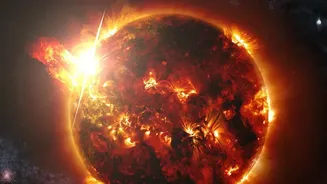
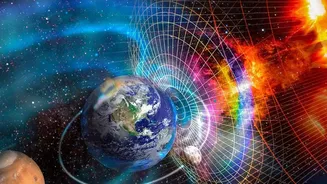
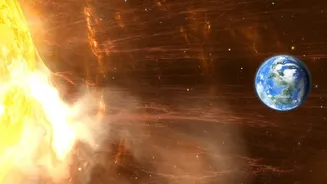
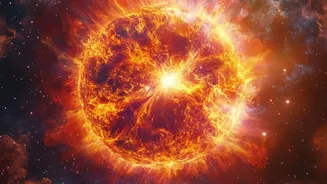
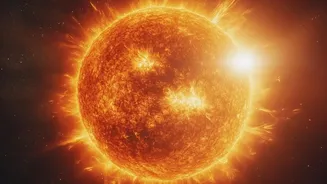
The Sun, the life-giving star at the center of our solar system, has a tempestuous side. It periodically unleashes enormous clouds of magnetised plasma and energy in what are known as coronal mass ejections, or CMEs. While our planet's magnetic field,
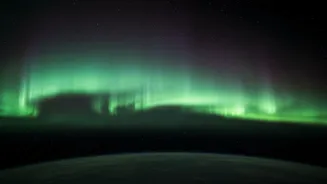
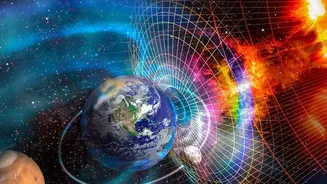
the magnetosphere, deflects most of this solar onslaught, a direct hit can be a different story. When a powerful CME slams into our magnetosphere, it can trigger a geomagnetic storm — a major disturbance that can have serious consequences for us on the ground. These aren't just pretty light shows like the aurora borealis; they are raw displays of cosmic power that can interact with our technological world in dangerous ways.
The High-Tech Risk
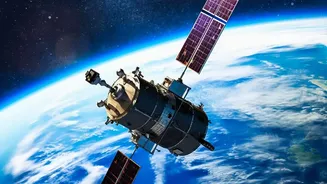
The invisible currents induced by geomagnetic storms pose a significant threat to the backbone of modern society. Long conductors, like the wires in our national power grids, can be overwhelmed by these geomagnetically induced currents. The result can be catastrophic, potentially leading to damaged transformers and widespread, long-lasting blackouts. A stark reminder of this vulnerability came in March 1989, when a solar storm plunged six million people in Quebec, Canada, into darkness for nine hours. Beyond the power grid, these storms can damage critical satellites used for communications and GPS, disrupt radio signals, and force airlines to reroute flights to avoid radiation exposure at high altitudes.
A Leap in Forecasting
For years, predicting the precise arrival and intensity of a CME has been a major challenge. Forecasters could see a CME leave the Sun but could only track it for a small portion of its journey, leaving a massive window of uncertainty — often as wide as five hours — for its arrival at Earth. This limited our ability to take effective defensive measures. However, recent advancements are changing the game. Using data from new missions like NASA's PUNCH (Polarimeter to Unify the Corona and Heliosphere), launched in 2025, scientists are developing sophisticated new models that provide a much clearer and faster picture.
How the New Models Work
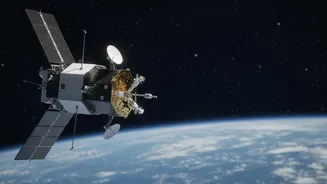
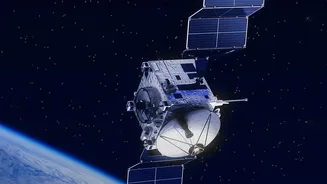
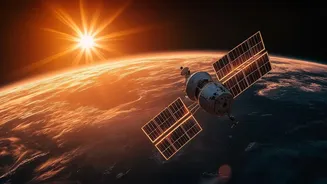
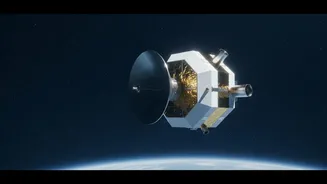
The PUNCH mission uses a constellation of four small satellites to continuously image a CME's entire journey from the Sun to Earth. Before this, instruments could only track about one-fifth of the trip. By feeding this constant stream of 3D observational data into advanced computer models, scientists can now track the storm's speed, trajectory, and evolution in near real-time. In a recent proof-of-concept test using data from a 2025 event, this new method predicted a CME’s arrival with an accuracy of within 30 minutes. This represents a tenfold improvement over older methods. It’s a change that one lead researcher described as the space weather equivalent of moving from a steam engine to a modern internal combustion engine.
More Time to Prepare
So, what does a more accurate, hours-long warning mean in practical terms? It's a game-changer for protecting our infrastructure. With a reliable and precise forecast, power grid operators have enough time to take preventative measures, like rerouting power or temporarily taking sensitive equipment offline to prevent permanent damage. Satellite operators can command their spacecraft into a protective safe mode, shielding delicate electronics from harmful radiation. Airlines can adjust flight paths to ensure the safety of passengers and crew. Essentially, this advanced warning system allows us to move from being reactive victims of space weather to proactive managers of its risks.