

A New Star Appears
In early October 1604, observers across Europe, China, and Korea noted a startling new light in the constellation Ophiuchus. This 'new star' was so bright it was visible during the day for over three weeks and outshone every star and planet in the night
sky. The German astronomer Johannes Kepler studied it so extensively that the event now bears his name: Kepler's Supernova, or SN 1604. At the time, such an event was world-altering, challenging the prevailing Aristotelian idea that the heavens were perfect and unchanging. Little did they know, they were not witnessing the birth of a star, but the spectacular death of one, an event so powerful its aftermath is still one of astronomy's most compelling subjects.
The Cosmic Crime Scene
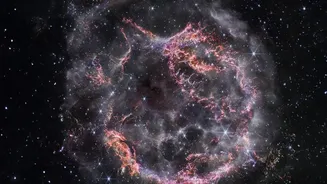
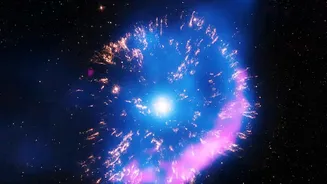
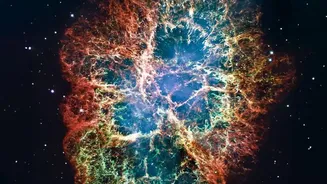
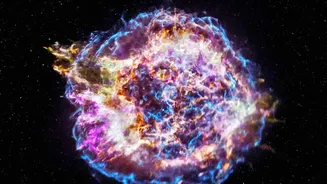
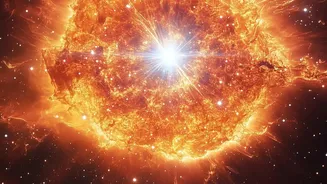
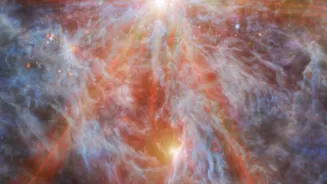
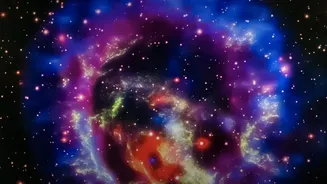
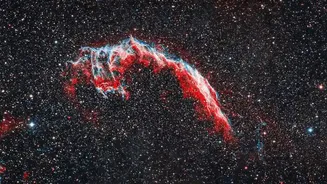
The light from SN 1604 faded from naked-eye view after about 18 months. For centuries, the story ended there. But with the advent of modern telescopes, astronomers could finally revisit the scene. What they found was a stunning, knotty shell of gas and dust, known as a supernova remnant, expanding outwards from the site of the explosion. Using instruments like NASA's Chandra X-ray Observatory, the Hubble Space Telescope, and the Spitzer Space Telescope, scientists can view the remnant in different wavelengths of light, essentially performing a cosmic autopsy. These multi-wavelength images reveal super-heated gas, the distribution of newly forged elements, and a powerful shockwave still racing through space at incredible speeds, some of it moving at 3% the speed of light.
Not a Massive Star, But Something Else
The headline asks what massive stars leave behind, but the story of SN 1604 has a twist. While some supernovas are caused by the collapse of a single, giant star (a Type II supernova), evidence overwhelmingly shows that Kepler's was a 'Type Ia' supernova. This kind of explosion happens in a binary star system where a small, dense star called a white dwarf siphons material from a companion. When the white dwarf gets too heavy—reaching about 1.4 times the mass of our sun—it triggers a runaway thermonuclear reaction, completely obliterating itself in a brilliant, uniform explosion. The composition of the debris, which lacks certain elements expected from a massive star's collapse, and the historical brightness records both point to a Type Ia event.
An Ongoing Mystery: Where is the Other Star?
Identifying SN 1604 as a Type Ia supernova solved one mystery but opened another that scientists are still debating. If the white dwarf stole matter from a companion star, what happened to it? The two main theories are the 'single-degenerate' model, where the companion was a normal or giant star that should have survived the blast, or the 'double-degenerate' model, where the companion was another white dwarf and the two merged, leaving nothing behind. Some evidence, like a disk-shaped structure and nitrogen-rich gas in the remnant, suggests a companion star was shedding material before the explosion. However, despite deep searches of the area, astronomers have found no trace of a surviving star. This lack of a 'smoking gun' has led some to believe that SN 1604 was the result of a cataclysmic merger between two white dwarfs.
Why Kepler's Supernova Still Matters
As the last supernova witnessed in our own galaxy, SN 1604 is a priceless laboratory for understanding stellar explosions. Type Ia supernovas are particularly crucial because their uniform brightness makes them 'standard candles'—cosmic mile-markers that allow astronomers to measure distances across the universe. It was by using these very explosions in distant galaxies that scientists discovered the universe's expansion is accelerating, a Nobel Prize-winning finding attributed to a mysterious force called dark energy. By studying the intricate details left behind by Kepler's star—the shape of the remnant, the elements it scattered, and the enduring mystery of its trigger—we refine our understanding of these essential cosmic tools and, in turn, our place in an ever-expanding cosmos.